When someone is setting up a bar or upgrading its sound system, the question is almost always the same: two large speakers in the corners, or several smaller speakers distributed across the ceiling? It may seem like a matter of budget or aesthetics, but it is not. It is a technical question with a clear answer.
A bar sound system does not work like concert sound or the hi-fi in your living room. Hospitality venues have very specific requirements: consistent coverage, comfortable conversation, minimal disturbance to neighbours and, if you have a noise limiter, compliance without leaving half the premises unable to hear the music. Two big speakers do not solve that. They make it worse.
This guide explains why, using real data and physics, without trying to sell you anything you do not need. If you then want someone to install it properly, we can talk.
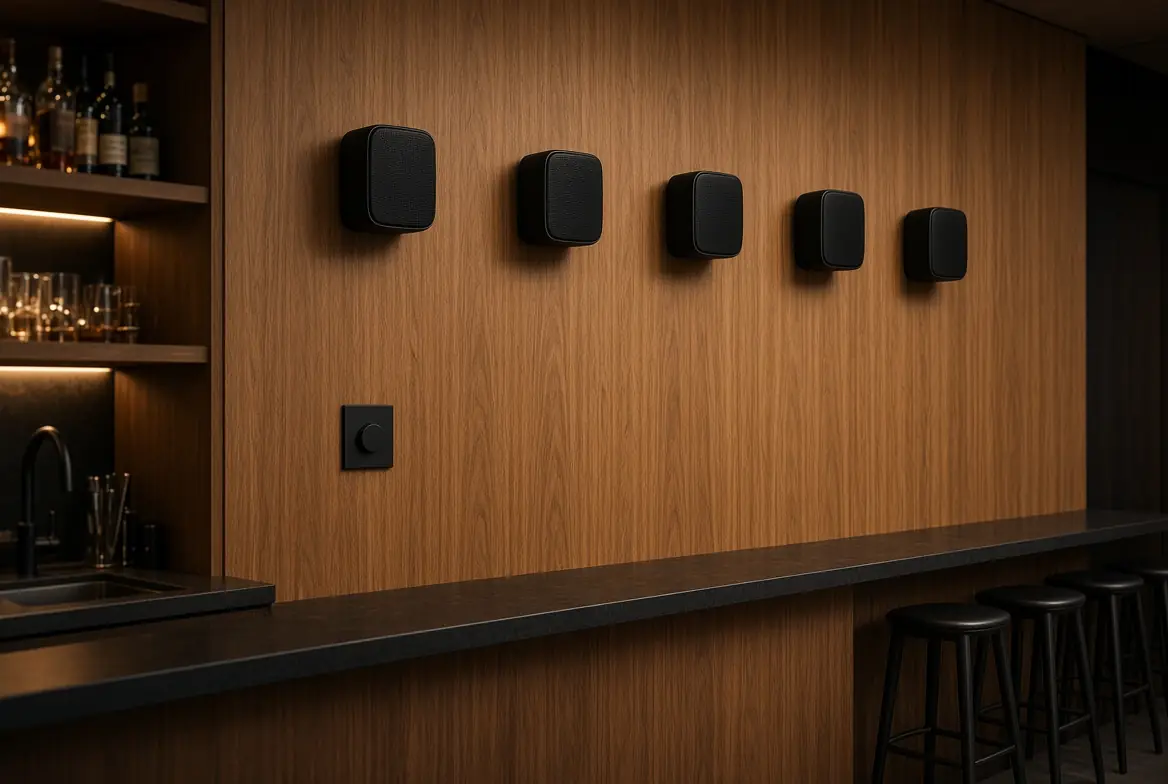
Why speaker size is not the real problem
Before getting into decibels and formulas, consider what a bar owner actually wants from the sound system.
They do not want the windows to shake. They want every customer to hear the music, nobody to have to shout across a table, neighbours not to call the police and the premises to meet noise regulations.
A poorly sized pair of large speakers undermines all four objectives. A distributed system with multiple smaller sources addresses them effectively.
The reason is physics, not opinion.
The physics that nobody explains in the shop: the inverse-square law
Here is the key principle. In free field, every time you double your distance from a loudspeaker, sound pressure level drops by approximately 6 dB.
That may not sound like much. It is.
Imagine a speaker delivering 80 dB at one metre:
| Distance from speaker | Approximate SPL |
|---|---|
| 1 metre | 80 dB |
| 2 metres | 74 dB |
| 4 metres | 68 dB |
| 8 metres | 62 dB |
Between the nearest table (two metres away) and the farthest (eight metres away) there is a difference of 12 dB. That is not merely a slight reduction in level; listeners at the back experience sound that is dramatically quieter.
How do you compensate for that with two big speakers? By turning them up. This means guests near the speakers endure uncomfortable levels while those at the back still struggle to hear. Meanwhile, neighbours hear that extra energy through the walls.
The answer is not more power. It is more sources, closer to listeners.
With distributed loudspeakers, customers can remain within two or three metres of a sound source. With proper design, level differences between tables can be kept very small, potentially below 3 dB. Guests hear more consistently, excessive hotspots are reduced and the overall system level can be lower.
Psychoacoustics in hospitality: hearing is not just listening
The science of psychoacoustics studies how the brain interprets sound. It helps explain why guests in a bar with two oversized speakers often end up shouting across their tables.
The Lombard effect: when the venue works against you
The Lombard effect is simple: people instinctively raise their voices in background noise. If speakers force customers near them to endure loud music, those customers speak more loudly. Their additional noise reaches other tables, whose occupants also raise their voices. Soon the bar can feel like a nightclub, even when the music itself is set to a seemingly reasonable level.
A distributed system interrupts this cycle because levels remain moderate and more even throughout the venue. There are fewer tables where raised voices spread across the room.
Direct versus reverberant sound: the battle for clarity
Far from a speaker, the direct sound reaching you is relatively weak. Sound reflected off the ceiling, walls and floor also reaches your ears slightly later. This is reverberant sound.
The greater the proportion of reverberant sound relative to direct sound, the harder music and conversations become to understand. Human speech and song lyrics lose definition and become blurred.
By placing loudspeakers closer to listeners, direct sound arrives clearly and strongly before the reverberant field masks it. Perceived quality can improve even while total system power decreases.
This is particularly important in restaurants with hard surfaces: terrazzo floors, tiled walls and plaster ceilings. These spaces may be easy to clean but acoustically challenging. Distributed sound helps alleviate the problem without necessarily requiring a complete acoustic renovation.
How to calculate ceiling-speaker coverage
Ceiling speakers are common in distributed hospitality installations. Their coverage can be estimated using a simple formula:
Coverage diameter = 2 × height above listener × tan(coverage angle / 2)
Practical example: a speaker with a nominal 90° coverage angle, mounted 2.5 metres above ear level:
- Estimated coverage diameter: 2 × 2.5 × tan(45°) = 5 metres
That means one speaker has an estimated coverage circle around five metres across. In a 10 × 8 metre bar, four to six units may provide useful coverage, depending on the desired overlap.
Two important points about this formula:
- It is a guide only. Real coverage changes with frequency. At low frequencies, speakers typically spread sound more widely; at higher frequencies, directivity narrows. The manufacturer's polar plots provide more reliable data.
- The goal is not covering the largest area with the fewest speakers. The goal is uniformity. Keeping level differences below 3 dB across occupied areas is a useful design target.
The neighbour problem: how distributed audio helps with noise compliance
This is a major concern for bar owners in Spain, with good reason. Noise penalties are real, enforcement can be slow and expensive, and complaints from neighbours can become a serious issue if the venue's system is poorly designed.
The logging noise limiter and its pitfalls
If you have a logging noise limiter installed (mandatory in many municipalities), you know there is a maximum level you cannot exceed. With two big loudspeakers, nearby tables can reach high levels quickly while distant tables still receive too little sound.
The result: the limiter reduces the signal when the monitored level reaches its threshold, but coverage at the back remains poor. Customers complain, the level is increased, the limiter acts again and the night becomes a cycle of interruptions.
A distributed system produces more consistent levels throughout the venue. The limiter can do its job properly because there are fewer extreme hotspots and coverage gaps. The overall volume can be lower without guests feeling the music is too quiet.
This does not mean that distributed audio bypasses the regulations. The total noise heard by neighbours depends on many things: the venue's insulation, low-frequency transmission paths and subwoofer placement. But a good distributed system supports compliance rather than making it more difficult.
Low-frequency noise: the quiet enemy
The two large speakers favoured by some shops often have more bass capability. Bass is precisely the hardest frequency range to contain acoustically and one of the most likely to disturb neighbours.
Smaller distributed loudspeakers combined with one or two well-placed subwoofers provide better control over how bass is produced and managed. You can cross over around 80–120 Hz, high-pass the compact speakers and handle low frequencies more precisely through DSP.
The objective is to reduce unnecessary low-frequency energy exciting the room and building structures.
Zoning: the distributed system's biggest advantage
A basic two-speaker installation has one level control: up or down. That is all.
A properly installed distributed system with a DSP matrix allows completely independent zones:
- Bar counter: more prominent music, passing customers and a livelier atmosphere.
- Dining area: moderate volume, comfortable conversation and background music.
- Booths or private rooms: lower level and a relaxed atmosphere.
- Terrace: fully independent control, especially important in noise-sensitive locations.
- Circulation areas: functional coverage without disturbance.
Each zone can have its own equalisation, level and preset. You can programme automatic scenes for different times of day: breakfast, lunch, quieter afternoons and lively evenings.
For hospitality operators this is not a luxury. It is a management tool. A venue should sound different at 10 a.m. and 11 p.m.; a well-designed distributed system handles this with one button or automatically.
100 V lines versus low impedance: which cabling system to choose?
With many distributed speakers, cabling can become complicated. There are two main options.
100 V (or 70 V) speaker lines
Constant-voltage lines (100 V in Europe, 70 V in the US) are standard in many hospitality and public-address installations. Their advantages include:
- Simplified wiring: speakers are connected in parallel on a line, with the overall load determined by their transformer taps.
- Flexibility: each speaker has a transformer with selectable power taps (for example 1 W, 2 W or 5 W), making it easier to balance levels across zones.
- Long cable runs: higher distribution voltage reduces cable losses, allowing runs of tens of metres without significant degradation when designed correctly.
They are well suited to installations with many speaker locations, long cable runs and multiple zones.
Low impedance (4–8 ohms)
Low-impedance systems are common in hi-fi and high-performance professional audio. Their advantages include:
- High audio fidelity in small, controlled installations.
- Low cable losses over short runs with suitable cable sizes.
- They allow a broad selection of high-quality, wide-bandwidth speakers.
They suit small bars, VIP areas and venues where sound quality is critical and cable runs are short.
Many professional installations combine both: low impedance for premium areas and 100 V distribution for general background sound.
Preventing speaker interference: the most common mistake
Installing lots of speakers without planning does not improve sound. It can ruin it. The main issue is interference between sources when the same signal reaches a listener from several speakers at slightly different times.
This phenomenon is called comb filtering (comb filtering) and produces tonal colouration, loss of clarity and notches in frequency response. It does not sound like 'more sound'; it sounds odd and fatiguing.
To prevent this:
- Control overlap between speakers. Not every part of a speaker's coverage needs to be covered by its neighbour. A controlled overlap, often around 30–50% depending on layout and directivity, can help provide uniform coverage.
- Maintain correct polarity. A speaker wired with reversed polarity can partly cancel the output of nearby speakers. It is easy to prevent and damaging when ignored.
- Use delays where necessary. Where speakers are different distances along a sound path, DSP delays can time-align sources and reduce audible echoes.
- Use a mono signal. For background-music systems, mono playback ensures everyone receives the full musical programme regardless of position. Stereo distribution can be difficult to implement effectively and may add unnecessary complexity.
- Measure at multiple positions. One measurement in the middle of the venue tells only part of the story. Check tables at the rear, positions near speakers, corners and the most exposed locations.
Small loudspeakers and a subwoofer: an effective combination
Compact speakers have a physical limitation: they cannot reproduce deep bass at high levels. Their cones are small, excursion is limited and forcing them to play bass increases distortion while reducing dynamic headroom.
The solution is not necessarily larger speakers. It is to separate their roles:
- Distributed compact speakers: midrange and treble, consistent coverage, positioned close to listeners.
- One or two subwoofers: bass, strategically placed and managed through DSP.
The crossover is commonly set between 80 and 120 Hz, depending on the loudspeakers and room. High-passing compact speakers removes frequencies they cannot reproduce effectively, reducing distortion and increasing headroom before overload.
One critical detail often overlooked: phase and delay around the crossover frequency. If subwoofers and main speakers are not time-aligned, the crossover region becomes uneven, with cancellations and peaks that depend on listener position. This should be measured and corrected, not left to guesswork.
Subwoofer placement also matters greatly. Bass becomes broadly omnidirectional at low frequencies, but interactions with walls create nodes and antinodes: areas of reinforcement and cancellation. One table may hear very different bass from the next. Measuring and correcting through DSP makes a real difference.
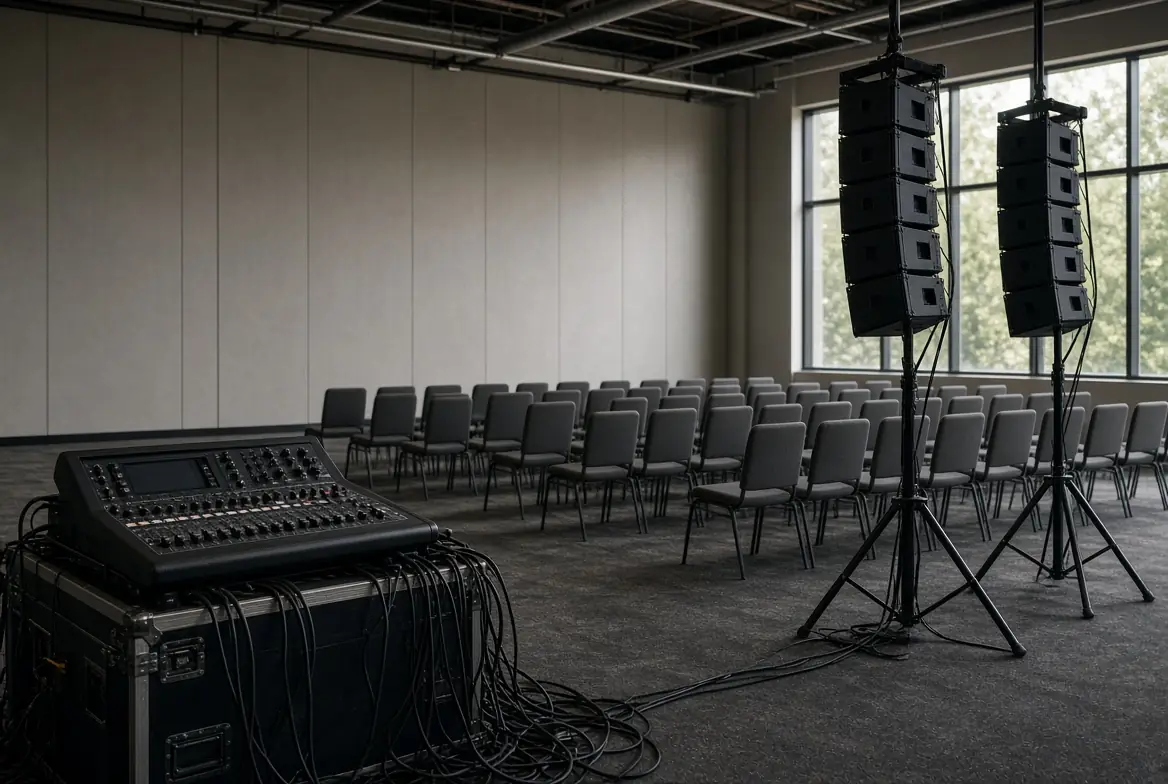
When two big speakers make sense (and when they do not)
To be fair, two large speakers are a sensible solution in some situations.
They can make sense when:
- The venue is very small (under 30–40 m²) and customers are at similar distances from the speakers.
- The budget is extremely limited and perfect uniformity is not critical.
- The system is temporary or provisional.
- The room is very long and narrow and two carefully aimed speakers achieve acceptable level variation throughout.
They are generally unsuitable when:
- The venue is larger than 50–60 m² and has different functional zones.
- There are neighbours and a logging noise limiter is installed.
- Conversation and speech intelligibility matter (restaurant or café).
- Independent zoning is required.
- Precise control over levels and the quality sound quality at each position is important.
For medium and large hospitality venues , distributed audio is usually the better choice. Not because it is fashionable, but because it solves real operational problems.
Conclusion
The choice between many small speakers and two large ones is not merely aesthetic or personal preference. It comes down to physics, psychoacoustics practical acoustics and noise regulations.
A well-designed bar sound system provides consistent coverage, operates at moderate levels, allows intelligent zoning, reduces the chance of neighbours being disturbed and works with the noise limiter without compromising customer experience. A distributed system can achieve all of this. Two oversized cabinets in opposite corners generally cannot.
If you are in Málaga or Marbella and need someone to measure, design and install the system properly—with a site survey, frequency-response measurements in each zone and the necessary limiter documentation—RinconRock provides exactly that. No empty promises, no oversizing and no unnecessary equipment.
A good sound system should blend into the experience. That is precisely what makes it work.
Unsure which system suits your venue? Leave a comment or contact us directly. We will answer without obligation or endless forms.
When someone is setting up a bar or upgrading its sound system, the question is almost always the same: two large speakers in the corners, or several smaller speakers distributed across the ceiling? It may seem like a matter of budget or aesthetics, but it is not. It is a technical question with a clear answer.
A bar sound system does not work like concert sound or the hi-fi in your living room. Hospitality venues have very specific requirements: consistent coverage, comfortable conversation, minimal disturbance to neighbours and, if you have a noise limiter, compliance without leaving half the premises unable to hear the music. Two big speakers do not solve that. They make it worse.
This guide explains why, using real data and physics, without trying to sell you anything you do not need. If you then want someone to install it properly, we can talk.
Why speaker size is not the real problem
Before getting into decibels and formulas, consider what a bar owner actually wants from the sound system.
They do not want the windows to shake. They want every customer to hear the music, nobody to have to shout across a table, neighbours not to call the police and the premises to meet noise regulations.
A poorly sized pair of large speakers undermines all four objectives. A distributed system with multiple smaller sources addresses them effectively.
The reason is physics, not opinion.
The physics that nobody explains in the shop: the inverse-square law
Here is the key principle. In free field, every time you double your distance from a loudspeaker, sound pressure level drops by approximately 6 dB.
That may not sound like much. It is.
Imagine a speaker delivering 80 dB at one metre:
| Distance from speaker | Approximate SPL |
|---|---|
| 1 metre | 80 dB |
| 2 metres | 74 dB |
| 4 metres | 68 dB |
| 8 metres | 62 dB |
Between the nearest table (two metres away) and the farthest (eight metres away) there is a difference of 12 dB. That is not merely a slight reduction in level; listeners at the back experience sound that is dramatically quieter.
How do you compensate for that with two big speakers? By turning them up. This means guests near the speakers endure uncomfortable levels while those at the back still struggle to hear. Meanwhile, neighbours hear that extra energy through the walls.
The answer is not more power. It is more sources, closer to listeners.
With distributed loudspeakers, customers can remain within two or three metres of a sound source. With proper design, level differences between tables can be kept very small, potentially below 3 dB. Guests hear more consistently, excessive hotspots are reduced and the overall system level can be lower.
Psychoacoustics in hospitality: hearing is not just listening
The science of psychoacoustics studies how the brain interprets sound. It helps explain why guests in a bar with two oversized speakers often end up shouting across their tables.
The Lombard effect: when the venue works against you
The Lombard effect is simple: people instinctively raise their voices in background noise. If speakers force customers near them to endure loud music, those customers speak more loudly. Their additional noise reaches other tables, whose occupants also raise their voices. Soon the bar can feel like a nightclub, even when the music itself is set to a seemingly reasonable level.
A distributed system interrupts this cycle because levels remain moderate and more even throughout the venue. There are fewer tables where raised voices spread across the room.
Direct versus reverberant sound: the battle for clarity
Far from a speaker, the direct sound reaching you is relatively weak. Sound reflected off the ceiling, walls and floor also reaches your ears slightly later. This is reverberant sound.
The greater the proportion of reverberant sound relative to direct sound, the harder music and conversations become to understand. Human speech and song lyrics lose definition and become blurred.
By placing loudspeakers closer to listeners, direct sound arrives clearly and strongly before the reverberant field masks it. Perceived quality can improve even while total system power decreases.
This is particularly important in restaurants with hard surfaces: terrazzo floors, tiled walls and plaster ceilings. These spaces may be easy to clean but acoustically challenging. Distributed sound helps alleviate the problem without necessarily requiring a complete acoustic renovation.
How to calculate ceiling-speaker coverage
Ceiling speakers are common in distributed hospitality installations. Their coverage can be estimated using a simple formula:
Coverage diameter = 2 × height above listener × tan(coverage angle / 2)
Practical example: a speaker with a nominal 90° coverage angle, mounted 2.5 metres above ear level:
- Estimated coverage diameter: 2 × 2.5 × tan(45°) = 5 metres
That means one speaker has an estimated coverage circle around five metres across. In a 10 × 8 metre bar, four to six units may provide useful coverage, depending on the desired overlap.
Two important points about this formula:
- It is a guide only. Real coverage changes with frequency. At low frequencies, speakers typically spread sound more widely; at higher frequencies, directivity narrows. The manufacturer's polar plots provide more reliable data.
- The goal is not covering the largest area with the fewest speakers. The goal is uniformity. Keeping level differences below 3 dB across occupied areas is a useful design target.
The neighbour problem: how distributed audio helps with noise compliance
This is a major concern for bar owners in Spain, with good reason. Noise penalties are real, enforcement can be slow and expensive, and complaints from neighbours can become a serious issue if the venue's system is poorly designed.
The logging noise limiter and its pitfalls
If you have a logging noise limiter installed (mandatory in many municipalities), you know there is a maximum level you cannot exceed. With two big loudspeakers, nearby tables can reach high levels quickly while distant tables still receive too little sound.
The result: the limiter reduces the signal when the monitored level reaches its threshold, but coverage at the back remains poor. Customers complain, the level is increased, the limiter acts again and the night becomes a cycle of interruptions.
A distributed system produces more consistent levels throughout the venue. The limiter can do its job properly because there are fewer extreme hotspots and coverage gaps. The overall volume can be lower without guests feeling the music is too quiet.
This does not mean that distributed audio bypasses the regulations. The total noise heard by neighbours depends on many things: the venue's insulation, low-frequency transmission paths and subwoofer placement. But a good distributed system supports compliance rather than making it more difficult.
Low-frequency noise: the quiet enemy
The two large speakers favoured by some shops often have more bass capability. Bass is precisely the hardest frequency range to contain acoustically and one of the most likely to disturb neighbours.
Smaller distributed loudspeakers combined with one or two well-placed subwoofers provide better control over how bass is produced and managed. You can cross over around 80–120 Hz, high-pass the compact speakers and handle low frequencies more precisely through DSP.
The objective is to reduce unnecessary low-frequency energy exciting the room and building structures.
Zoning: the distributed system's biggest advantage
A basic two-speaker installation has one level control: up or down. That is all.
A properly installed distributed system with a DSP matrix allows completely independent zones:
- Bar counter: more prominent music, passing customers and a livelier atmosphere.
- Dining area: moderate volume, comfortable conversation and background music.
- Booths or private rooms: lower level and a relaxed atmosphere.
- Terrace: fully independent control, especially important in noise-sensitive locations.
- Circulation areas: functional coverage without disturbance.
Each zone can have its own equalisation, level and preset. You can programme automatic scenes for different times of day: breakfast, lunch, quieter afternoons and lively evenings.
For hospitality operators this is not a luxury. It is a management tool. A venue should sound different at 10 a.m. and 11 p.m.; a well-designed distributed system handles this with one button or automatically.
100 V lines versus low impedance: which cabling system to choose?
With many distributed speakers, cabling can become complicated. There are two main options.
100 V (or 70 V) speaker lines
Constant-voltage lines (100 V in Europe, 70 V in the US) are standard in many hospitality and public-address installations. Their advantages include:
- Simplified wiring: speakers are connected in parallel on a line, with the overall load determined by their transformer taps.
- Flexibility: each speaker has a transformer with selectable power taps (for example 1 W, 2 W or 5 W), making it easier to balance levels across zones.
- Long cable runs: higher distribution voltage reduces cable losses, allowing runs of tens of metres without significant degradation when designed correctly.
They are well suited to installations with many speaker locations, long cable runs and multiple zones.
Low impedance (4–8 ohms)
Low-impedance systems are common in hi-fi and high-performance professional audio. Their advantages include:
- High audio fidelity in small, controlled installations.
- Low cable losses over short runs with suitable cable sizes.
- They allow a broad selection of high-quality, wide-bandwidth speakers.
They suit small bars, VIP areas and venues where sound quality is critical and cable runs are short.
Many professional installations combine both: low impedance for premium areas and 100 V distribution for general background sound.
Preventing speaker interference: the most common mistake
Installing lots of speakers without planning does not improve sound. It can ruin it. The main issue is interference between sources when the same signal reaches a listener from several speakers at slightly different times.
This phenomenon is called comb filtering (comb filtering) and produces tonal colouration, loss of clarity and notches in frequency response. It does not sound like 'more sound'; it sounds odd and fatiguing.
To prevent this:
- Control overlap between speakers. Not every part of a speaker's coverage needs to be covered by its neighbour. A controlled overlap, often around 30–50% depending on layout and directivity, can help provide uniform coverage.
- Maintain correct polarity. A speaker wired with reversed polarity can partly cancel the output of nearby speakers. It is easy to prevent and damaging when ignored.
- Use delays where necessary. Where speakers are different distances along a sound path, DSP delays can time-align sources and reduce audible echoes.
- Use a mono signal. For background-music systems, mono playback ensures everyone receives the full musical programme regardless of position. Stereo distribution can be difficult to implement effectively and may add unnecessary complexity.
- Measure at multiple positions. One measurement in the middle of the venue tells only part of the story. Check tables at the rear, positions near speakers, corners and the most exposed locations.
Small loudspeakers and a subwoofer: an effective combination
Compact speakers have a physical limitation: they cannot reproduce deep bass at high levels. Their cones are small, excursion is limited and forcing them to play bass increases distortion while reducing dynamic headroom.
The solution is not necessarily larger speakers. It is to separate their roles:
- Distributed compact speakers: midrange and treble, consistent coverage, positioned close to listeners.
- One or two subwoofers: bass, strategically placed and managed through DSP.
The crossover is commonly set between 80 and 120 Hz, depending on the loudspeakers and room. High-passing compact speakers removes frequencies they cannot reproduce effectively, reducing distortion and increasing headroom before overload.
One critical detail often overlooked: phase and delay around the crossover frequency. If subwoofers and main speakers are not time-aligned, the crossover region becomes uneven, with cancellations and peaks that depend on listener position. This should be measured and corrected, not left to guesswork.
Subwoofer placement also matters greatly. Bass becomes broadly omnidirectional at low frequencies, but interactions with walls create nodes and antinodes: areas of reinforcement and cancellation. One table may hear very different bass from the next. Measuring and correcting through DSP makes a real difference.
When two big speakers make sense (and when they do not)
To be fair, two large speakers are a sensible solution in some situations.
They can make sense when:
- The venue is very small (under 30–40 m²) and customers are at similar distances from the speakers.
- The budget is extremely limited and perfect uniformity is not critical.
- The system is temporary or provisional.
- The room is very long and narrow and two carefully aimed speakers achieve acceptable level variation throughout.
They are generally unsuitable when:
- The venue is larger than 50–60 m² and has different functional zones.
- There are neighbours and a logging noise limiter is installed.
- Conversation and speech intelligibility matter (restaurant or café).
- Independent zoning is required.
- Precise control over levels and the quality sound quality at each position is important.
For medium and large hospitality venues , distributed audio is usually the better choice. Not because it is fashionable, but because it solves real operational problems.
Conclusion
The choice between many small speakers and two large ones is not merely aesthetic or personal preference. It comes down to physics, psychoacoustics practical acoustics and noise regulations.
A well-designed bar sound system provides consistent coverage, operates at moderate levels, allows intelligent zoning, reduces the chance of neighbours being disturbed and works with the noise limiter without compromising customer experience. A distributed system can achieve all of this. Two oversized cabinets in opposite corners generally cannot.
If you are in Málaga or Marbella and need someone to measure, design and install the system properly—with a site survey, frequency-response measurements in each zone and the necessary limiter documentation—RinconRock provides exactly that. No empty promises, no oversizing and no unnecessary equipment.
A good sound system should blend into the experience. That is precisely what makes it work.
Unsure which system suits your venue? Leave a comment or contact us directly. We will answer without obligation or endless forms.
Start writing here...
Sound Systems for Bars and Pubs