WEDDINGS AND EVENTS
Most technical problems at weddings are not caused by insufficient power. They arise because the ceremony, cocktail reception, wedding breakfast and dancing require different systems, yet the entire event is expected to run on a pair of speakers and a wireless microphone. Once the officiant begins speaking and wind overloads the microphone capsule, the advertised wattage no longer matters. The same applies when some tables cannot hear speeches or the DJ discovers that the electrical installation cannot support the planned lighting.
A properly planned audiovisual production begins with the event schedule: spaces, transitions, timings, guest numbers, musical programme, microphones, power supplies and coordination with the venue. At estates, country houses and hotels on the Costa del Sol, outdoor conditions, aesthetics and applicable noise limits also need consideration.
This guide explains what equipment to prepare for each stage, how to distribute it and which checks help prevent faults before guests arrive.
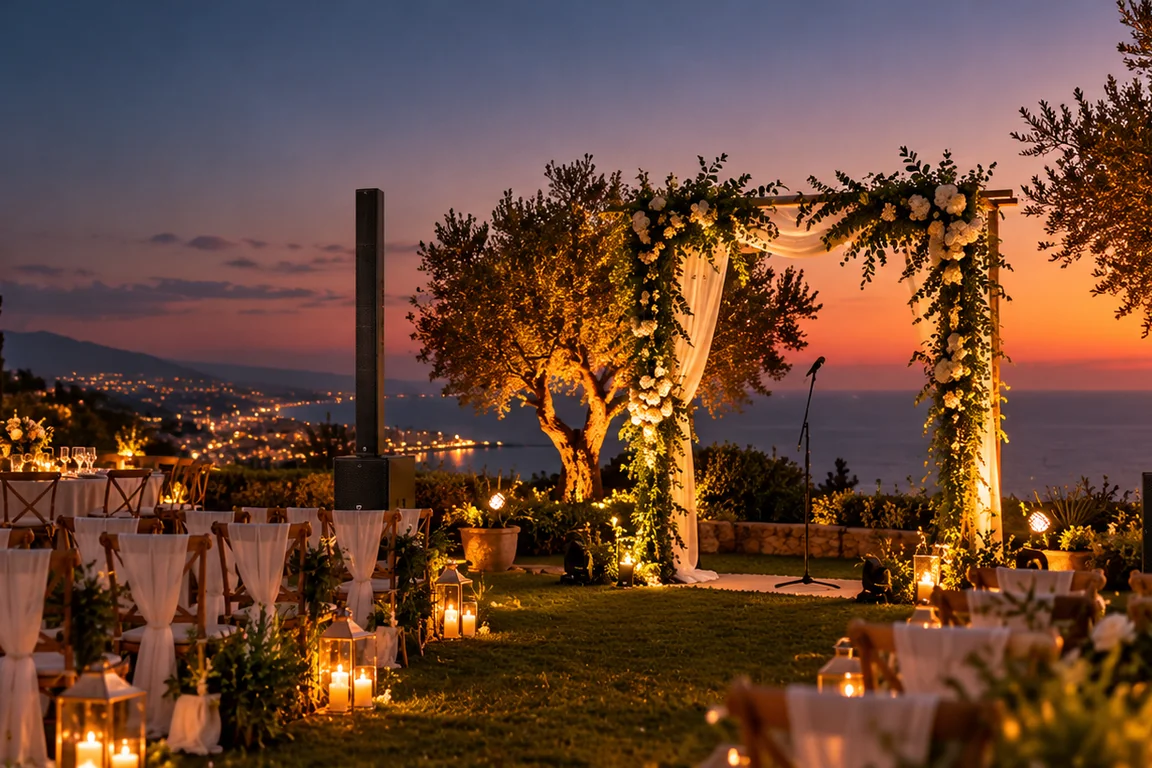
4 STAGES
CEREMONY · COCKTAILS · DINNER · DANCING
RF
RELIABLE WIRELESS MICROPHONES
PLAN B
BACKUP AND WEATHER
01 · WEDDINGS AND EVENTS
1. One wedding, four different acoustic events
The ceremony prioritises speech intelligibility: every guest should understand the officiant and vows even with quiet background music. At the cocktail reception, the priority becomes consistent coverage without forcing people to raise their voices. Dinner calls for controlled levels, occasional speeches and potentially several sound zones. Finally, dancing requires a different SPL range, bass reproduction and dynamic headroom.
| Area | Priority | Typical requirements |
|---|---|---|
| Ceremony | Clear speech and entrance music | Microphones, compact PA, mixer and backup |
| Cocktail reception | Even ambient sound | Distributed sources, level control, music |
| Dinner | Conversation and speeches | Zones, handheld microphone, coordinated playback |
| Party | Music and energy | Main PA, subwoofers, DJ connections, lighting |
The mistake is physically moving the same equipment between stages without leaving enough time, forcing the ceremony setup to be dismantled just as guests begin the cocktail reception. At many venues, independent systems are more reliable, or at least pre-wired audio routes and zones.
Practical tip: design the setup around how guests move through the venue. If cocktails begin while the altar is still being dismantled, they cannot depend on the same cables or loudspeakers currently serving the ceremony.
02 · WEDDINGS AND EVENTS
2. How many speakers does an outdoor ceremony need?
There is no universal guests-to-watts ratio. A highly sensitive loudspeaker can cover a longer distance than one with a higher nominal electrical power rating. Geometry, directivity and background noise matter as much as attendance.
At an outdoor ceremony, without a room reflecting reverberant energy evenly, speech should reach the last rows clearly without becoming uncomfortable for the first. Often this is better achieved with two well-aimed column or compact loudspeakers, positioned to avoid microphone feedback. Long spaces or obstructed sightlines may call for additional reinforcement farther away.
Sound pressure falls by approximately 6 dB each time distance doubles in free field for a point source. Therefore, a back row 16 metres away does not receive the same direct sound as a front row four metres away. Raising the overall level indiscriminately also increases it at the front.
Useful check: walk from the altar to the last seat while listening to a real person speaking at a normal level, not only prerecorded music. Intelligibility, wind and feedback should be assessed in the least favourable positions.
03 · WEDDINGS AND EVENTS
3. Choosing the right microphone for the vows
A ceremony may involve three distinct needs: the officiant, readings by family members and the couple's vows. Sharing one handheld microphone can work, but requires clear organisation. A discreet lavalier may look better, although its distance from the mouth and exposure to clothing noise affect the signal.
Handheld microphone: robust, easy to pass between speakers and offers fairly predictable pickup when held at the correct distance. If each reader holds it differently, usable gain changes and feedback may occur.
Lavalier or headset: keeps hands free but requires careful placement, movement tests and wind protection. A properly fitted headset usually maintains a more consistent distance from the mouth.
Lectern or gooseneck microphone: practical when speeches take place at a fixed position and the capsule can be aimed appropriately.
Practical tip: assign a role and a responsible person to each microphone. Prepare batteries, spares and a working wired microphone as a backup. The decision should not be based solely on which option is least visible in photographs.
04 · WEDDINGS AND EVENTS
4. Radio frequency is part of the production
A wireless microphone may work perfectly during setup yet fail when the audience arrives, other transmitters appear or equipment positions change. RF coverage depends on the frequency band, coordination between systems, antennas, metal structures and people obstructing the signal path.
Professional practice includes finding available frequencies, coordinating simultaneous systems, maintaining a clear path between transmitters and receiver antennas and testing with all units switched on. Antennas hidden behind a metal rack or placed at floor level can seriously impair reception.
Do not assume a frequency that was clear during a morning test will remain usable throughout the event. Advance coordination is particularly important at hotels hosting several weddings, conferences or other AV suppliers.
RF checklist:
- Check transmitter frequency bands and the frequencies permitted locally.
- Scan with the final RF setup whenever possible.
- Coordinate channels to avoid interference and significant intermodulation.
- Install antennas with a clear signal path and suitable cabling.
- Test at the altar, lectern, aisle and speaking positions.
- Keep an alternative microphone or channel available.
Good microphones also require properly set mixer gain: gain structure should not be improvised while someone is reading their vows. The Shure antenna placement recommendations provide a useful technical reference for these checks.
05 · WEDDINGS AND EVENTS
5. Wind, beaches and open estates: predictable problems
Wind introduces very low-frequency noise into a microphone capsule and can turn intelligible speech into an overloaded signal dominated by thumps. A high-pass filter helps reduce unwanted content but does not replace suitable wind protection. Outdoors, test capsules at the actual ceremony time, when conditions may differ from setup.
Coastal locations also bring salt, humidity, sand and sudden temperature changes. Keep equipment and connections away from irrigation, swimming pools, fountains and direct splashes. Covers and cable runs must not compromise safe access.
In gardens, cables can easily disappear among grass, decorations and walkways. Even where this improves aesthetics, cable routes must remain protected, documented and accessible. Simply covering a cable with a rug does not automatically create a safe cable crossing.
Practical tip: prepare two versions of the setup, outdoor and indoor, with a short changeover checklist, available equipment and named responsibilities. The backup plan should not rely on moving the entire system while guests are waiting.
06 · WEDDINGS AND EVENTS
6. What a cocktail reception really needs
During cocktails, guests move around, gather in small groups and talk. Music should cover a broad area without becoming the focus of attention. On a long terrace or in a garden with several zones, multiple sources at moderate levels can therefore work better than a single loud pair of speakers.
Speaker spacing should reflect their directivity and the occupied areas. Where several sources play the same signal, overlap and relevant timing differences need managing. For background music, mono distribution often prevents guests near only one speaker from missing part of a stereo mix.
Live musicians change the requirements. An acoustic duo, a string quartet and a saxophonist playing to backing tracks do not need the same microphones or monitors. It is preferable to prepare a small mixer or separate stage input and agree on the connection point and soundcheck.
Practical tip: create separate control zones for terraces, gardens and covered spaces. This allows the atmosphere to be adjusted without affecting the rest of the venue or having to visit each amplifier.
07 · WEDDINGS AND EVENTS
7. Dinner speeches: a common weak point at weddings
Speeches seem simple: just hand someone a microphone. In practice, speakers move around, hold the microphone too far from their mouths, approach loudspeakers and may speak much more quietly than during soundcheck.
In a large dining area, one pair of speakers near the top table may not be enough. Nearby tables receive excessive sound while those at the back struggle to understand. Zoned audio or small reinforcement speakers can improve distribution without unnecessarily increasing the level of the main system.
Before dinner, run a spoken-word test and check that the mixer has headroom before feedback starts. Microphone equalisation should be adjusted to the sound system, rather than relying solely on increased gain.
If a speech includes video, check audio from the playback device, output level, HDMI or network connections, file format and playback order. Testing a video only on a laptop is not a test of the complete system.
Practical tip: ask the speech coordinator for a running order and assign someone specifically to hand over and collect the microphone. This simple operational measure avoids unnecessary silence.
08 · WEDDINGS AND EVENTS
8. How to size the PA for dancing
DJ music needs more dynamic headroom than speech. The system should be selected based on dance-floor area, audience distance, background noise, musical style and operating limits. A cabinet's RMS wattage alone does not establish its usable SPL; sensitivity, directivity, processing and thermal capacity also matter.
The main speakers should cover the dance floor without directing excessive energy towards tables that remain occupied. Subwoofer placement relative to walls, stages and guests needs particular care. Moving them can significantly change bass distribution, but does not guarantee reduced disturbance outside.
A typical medium-sized dance setup uses a properly distributed stereo or mono main system, subwoofers as required and a processor with filters, limiting and alignment adjustments. The exact selection depends on real equipment performance and the venue, not a fixed number of speakers per hundred people.
Practical tip: ask the DJ about available outputs, nominal level, monitoring, controller space, power and soundcheck time. A distorted input signal cannot be fixed by using a better PA.
09 · WEDDINGS AND EVENTS
9. Wedding lighting: create atmosphere without turning everything into a stage
Lighting should complement each phase. During the ceremony, a restrained approach often works best with natural light and photography. At cocktails, festoon lights and warm accents help define routes and tables. During dinner, guests need to see food and faces without glare. Dynamic programming can be reserved for dancing.
Wireless uplights: can highlight columns, plants or architecture without visible cables, but actual battery life, charging, positioning and control reliability must be considered.
Festoon lighting: adds visual depth and a pleasant sense of space; anchor points and weather protection must be treated as technical installation requirements rather than decoration alone.
Moving heads and effects: can transform a dance floor but need coordinating with photography, venue operations and restrictions on light beams reaching neighbouring properties or public roads.
Practical tip: separate circuits or control groups for architectural lighting, dinner and the dance floor. Being able to disable dance effects while maintaining functional light simplifies operation and avoids abrupt transitions.
10 · WEDDINGS AND EVENTS
10. Power and safety at estates and country houses
Before loading the equipment, find out what electrical infrastructure the venue actually has. A socket near the stage does not mean there is enough available power for PA, lighting, catering, refrigeration and external suppliers at the same time.
System sizing must take account of actual consumption, maximum current, protection devices, phase distribution where relevant, cable runs and selectivity. An amplifier advertised as delivering thousands of watts does not continuously consume that figure during music playback, but peaks and the simultaneous loads of other equipment still matter.
Distribution boards, extensions and connectors must suit the environment and be protected against public access, rain and mechanical damage. Suspended equipment requires appropriate supports and secondary safety measures where necessary. Installation must be carried out by competent personnel in accordance with applicable regulations.
Practical tip: draw up an electrical plan showing loads before deciding cable routes. Ask the venue about loading restrictions, connection times and working alongside other suppliers.
11 · WEDDINGS AND EVENTS
11. Why setup schedules matter
The technical schedule should distinguish access, unloading, installation, tests, guest arrival, room changes and dismantling. A wedding ceremony at 6 p.m. does not allow microphone testing to begin at 5:55 p.m., especially when catering or decorators are using the same loading corridor.
Each area needs its own verification window: stable power, checked signal path, tested microphones, music playback from the actual source and reviewed levels. Coordination with the wedding planner, venue, musicians, DJ, photographer and catering helps avoid disruption at critical moments.
Several setup configurations may be needed during the same day. Dinner entrance music might come from a different player; the toast may require another microphone; and the first dance may involve lighting changes. These transitions need a simple cue sheet listing who is responsible and what triggers each cue.
Practical tip: ensure special audio files are downloaded locally with a backup copy. Relying on Wi-Fi congested by hundreds of phones creates an avoidable vulnerability.
12 · WEDDINGS AND EVENTS
12. What to ask when hiring wedding sound and lighting
Requesting 'equipment for 150 guests' is not enough. A useful proposal requires basic information affecting coverage, transport, power and crew:
- Date, town and exact venue.
- Approximate guest numbers at each event stage.
- Indoor and outdoor areas, with floor plans if available.
- Access, ceremony, cocktails, dinner and dancing times.
- Microphone requirements: officiant, musicians, speeches and presentations.
- DJ, band or performers, including their technical rider.
- Noise limits, permits and venue rules.
- Available power and other suppliers' electrical requirements.
- Lighting preferences and decorative restrictions.
- Rain or wind contingency plan.
| Budget item | What to clarify |
|---|---|
| Equipment | Models or performance specifications, quantities and intended coverage |
| Transport | Distance, access, unloading, parking and timings |
| Setup | Crew, rigging, cable runs and testing |
| Operation | Technician hours, changeovers and overtime |
| Backup | Microphone, music source, signal path and weather plan |
A complete quotation should explain what is included and excluded. Two offers may list similar speaker quantities yet differ substantially in operation, redundancy and setup time.
13 · WEDDINGS AND EVENTS
13. Common faults and how to prevent them
Microphone overloaded by wind. Provide physical wind protection, filters and a test at the actual position. EQ cannot remove every gust-induced thump.
Wireless dropouts. Coordinate frequencies, position antennas correctly, check batteries and prepare an alternative channel.
Speakers pointing towards microphones. Adjust placement, directivity and gain before the ceremony, with someone actually speaking.
Speeches inaudible at the back. Check every table's coverage and use fill speakers where necessary.
One system serving four separate locations. Plan a realistic changeover or set up independent zones to prevent service gaps.
DJ lacks a suitable connection. Check outputs, cables, levels and monitoring several days before the event.
Not enough electrical power for lighting. Review consumption, distribution board, protection and shared power with catering.
Weather changes with no contingency. Define which equipment moves, who moves it and what happens to sound in the meantime.
14 · WEDDINGS AND EVENTS
14. Frequently asked questions about wedding sound
How many watts are needed for 100 or 200 guests?
There is no fixed power rating that works in every case. Speaker sensitivity, actual occupancy by zone, distances, music and the environment all vary. It is better to specify the area and guest distribution so a target SPL and sufficient headroom can be established.
Are column speakers better than conventional cabinets?
Column speakers can provide discreet visual integration and useful coverage for ceremonies and cocktails. Conventional cabinets may be more suitable depending on distance, directivity and required level. Neither is universally better.
Do we need a technician throughout the wedding?
When the event involves venue changes, wireless microphones, musicians, speeches and lighting cues, professional operation reduces risks. A simple background-music installation has different requirements.
Can we use the hotel's loudspeakers?
That depends on coverage, connectivity, access to zones and conditions of use. Test the actual source, microphone and venue restrictions before relying on the installed system.
What happens if it rains?
There should be an agreed plan with the venue and all suppliers. Not all loudspeakers, connectors and luminaires can operate outdoors, and protecting equipment must not obstruct exits or access routes.
15 · WEDDINGS AND EVENTS
Conclusion: design around each moment, not speaker quantity
The best wedding sound system is one that lets guests hear every word, enjoy the atmosphere and move into dancing without interruptions. Achieving this means designing ceremony, cocktails, dinner and partying as distinct uses while coordinating microphones, RF, coverage, power and lighting.
RinconRock provides audiovisual services for wedding planners and equipment hire in Málaga, Marbella and the Costa del Sol. To discuss a specific date and venue, request information.
RINCONROCK RENTAL AV · RELATED RESOURCES
WEDDINGS AND EVENTS
Most technical problems at weddings are not caused by insufficient power. They arise because the ceremony, cocktail reception, wedding breakfast and dancing require different systems, yet the entire event is expected to run on a pair of speakers and a wireless microphone. Once the officiant begins speaking and wind overloads the microphone capsule, the advertised wattage no longer matters. The same applies when some tables cannot hear speeches or the DJ discovers that the electrical installation cannot support the planned lighting.
A properly planned audiovisual production begins with the event schedule: spaces, transitions, timings, guest numbers, musical programme, microphones, power supplies and coordination with the venue. At estates, country houses and hotels on the Costa del Sol, outdoor conditions, aesthetics and applicable noise limits also need consideration.
This guide explains what equipment to prepare for each stage, how to distribute it and which checks help prevent faults before guests arrive.
4 STAGES
CEREMONY · COCKTAILS · DINNER · DANCING
RF
RELIABLE WIRELESS MICROPHONES
PLAN B
BACKUP AND WEATHER
01 · WEDDINGS AND EVENTS
1. One wedding, four different acoustic events
The ceremony prioritises speech intelligibility: every guest should understand the officiant and vows even with quiet background music. At the cocktail reception, the priority becomes consistent coverage without forcing people to raise their voices. Dinner calls for controlled levels, occasional speeches and potentially several sound zones. Finally, dancing requires a different SPL range, bass reproduction and dynamic headroom.
| Area | Priority | Typical requirements |
|---|---|---|
| Ceremony | Clear speech and entrance music | Microphones, compact PA, mixer and backup |
| Cocktail reception | Even ambient sound | Distributed sources, level control, music |
| Dinner | Conversation and speeches | Zones, handheld microphone, coordinated playback |
| Party | Music and energy | Main PA, subwoofers, DJ connections, lighting |
The mistake is physically moving the same equipment between stages without leaving enough time, forcing the ceremony setup to be dismantled just as guests begin the cocktail reception. At many venues, independent systems are more reliable, or at least pre-wired audio routes and zones.
Practical tip: design the setup around how guests move through the venue. If cocktails begin while the altar is still being dismantled, they cannot depend on the same cables or loudspeakers currently serving the ceremony.
02 · WEDDINGS AND EVENTS
2. How many speakers does an outdoor ceremony need?
There is no universal guests-to-watts ratio. A highly sensitive loudspeaker can cover a longer distance than one with a higher nominal electrical power rating. Geometry, directivity and background noise matter as much as attendance.
At an outdoor ceremony, without a room reflecting reverberant energy evenly, speech should reach the last rows clearly without becoming uncomfortable for the first. Often this is better achieved with two well-aimed column or compact loudspeakers, positioned to avoid microphone feedback. Long spaces or obstructed sightlines may call for additional reinforcement farther away.
Sound pressure falls by approximately 6 dB each time distance doubles in free field for a point source. Therefore, a back row 16 metres away does not receive the same direct sound as a front row four metres away. Raising the overall level indiscriminately also increases it at the front.
Useful check: walk from the altar to the last seat while listening to a real person speaking at a normal level, not only prerecorded music. Intelligibility, wind and feedback should be assessed in the least favourable positions.
03 · WEDDINGS AND EVENTS
3. Choosing the right microphone for the vows
A ceremony may involve three distinct needs: the officiant, readings by family members and the couple's vows. Sharing one handheld microphone can work, but requires clear organisation. A discreet lavalier may look better, although its distance from the mouth and exposure to clothing noise affect the signal.
Handheld microphone: robust, easy to pass between speakers and offers fairly predictable pickup when held at the correct distance. If each reader holds it differently, usable gain changes and feedback may occur.
Lavalier or headset: keeps hands free but requires careful placement, movement tests and wind protection. A properly fitted headset usually maintains a more consistent distance from the mouth.
Lectern or gooseneck microphone: practical when speeches take place at a fixed position and the capsule can be aimed appropriately.
Practical tip: assign a role and a responsible person to each microphone. Prepare batteries, spares and a working wired microphone as a backup. The decision should not be based solely on which option is least visible in photographs.
04 · WEDDINGS AND EVENTS
4. Radio frequency is part of the production
A wireless microphone may work perfectly during setup yet fail when the audience arrives, other transmitters appear or equipment positions change. RF coverage depends on the frequency band, coordination between systems, antennas, metal structures and people obstructing the signal path.
Professional practice includes finding available frequencies, coordinating simultaneous systems, maintaining a clear path between transmitters and receiver antennas and testing with all units switched on. Antennas hidden behind a metal rack or placed at floor level can seriously impair reception.
Do not assume a frequency that was clear during a morning test will remain usable throughout the event. Advance coordination is particularly important at hotels hosting several weddings, conferences or other AV suppliers.
RF checklist:
- Check transmitter frequency bands and the frequencies permitted locally.
- Scan with the final RF setup whenever possible.
- Coordinate channels to avoid interference and significant intermodulation.
- Install antennas with a clear signal path and suitable cabling.
- Test at the altar, lectern, aisle and speaking positions.
- Keep an alternative microphone or channel available.
Good microphones also require properly set mixer gain: gain structure should not be improvised while someone is reading their vows. The Shure antenna placement recommendations provide a useful technical reference for these checks.
05 · WEDDINGS AND EVENTS
5. Wind, beaches and open estates: predictable problems
Wind introduces very low-frequency noise into a microphone capsule and can turn intelligible speech into an overloaded signal dominated by thumps. A high-pass filter helps reduce unwanted content but does not replace suitable wind protection. Outdoors, test capsules at the actual ceremony time, when conditions may differ from setup.
Coastal locations also bring salt, humidity, sand and sudden temperature changes. Keep equipment and connections away from irrigation, swimming pools, fountains and direct splashes. Covers and cable runs must not compromise safe access.
In gardens, cables can easily disappear among grass, decorations and walkways. Even where this improves aesthetics, cable routes must remain protected, documented and accessible. Simply covering a cable with a rug does not automatically create a safe cable crossing.
Practical tip: prepare two versions of the setup, outdoor and indoor, with a short changeover checklist, available equipment and named responsibilities. The backup plan should not rely on moving the entire system while guests are waiting.
06 · WEDDINGS AND EVENTS
6. What a cocktail reception really needs
During cocktails, guests move around, gather in small groups and talk. Music should cover a broad area without becoming the focus of attention. On a long terrace or in a garden with several zones, multiple sources at moderate levels can therefore work better than a single loud pair of speakers.
Speaker spacing should reflect their directivity and the occupied areas. Where several sources play the same signal, overlap and relevant timing differences need managing. For background music, mono distribution often prevents guests near only one speaker from missing part of a stereo mix.
Live musicians change the requirements. An acoustic duo, a string quartet and a saxophonist playing to backing tracks do not need the same microphones or monitors. It is preferable to prepare a small mixer or separate stage input and agree on the connection point and soundcheck.
Practical tip: create separate control zones for terraces, gardens and covered spaces. This allows the atmosphere to be adjusted without affecting the rest of the venue or having to visit each amplifier.
07 · WEDDINGS AND EVENTS
7. Dinner speeches: a common weak point at weddings
Speeches seem simple: just hand someone a microphone. In practice, speakers move around, hold the microphone too far from their mouths, approach loudspeakers and may speak much more quietly than during soundcheck.
In a large dining area, one pair of speakers near the top table may not be enough. Nearby tables receive excessive sound while those at the back struggle to understand. Zoned audio or small reinforcement speakers can improve distribution without unnecessarily increasing the level of the main system.
Before dinner, run a spoken-word test and check that the mixer has headroom before feedback starts. Microphone equalisation should be adjusted to the sound system, rather than relying solely on increased gain.
If a speech includes video, check audio from the playback device, output level, HDMI or network connections, file format and playback order. Testing a video only on a laptop is not a test of the complete system.
Practical tip: ask the speech coordinator for a running order and assign someone specifically to hand over and collect the microphone. This simple operational measure avoids unnecessary silence.
08 · WEDDINGS AND EVENTS
8. How to size the PA for dancing
DJ music needs more dynamic headroom than speech. The system should be selected based on dance-floor area, audience distance, background noise, musical style and operating limits. A cabinet's RMS wattage alone does not establish its usable SPL; sensitivity, directivity, processing and thermal capacity also matter.
The main speakers should cover the dance floor without directing excessive energy towards tables that remain occupied. Subwoofer placement relative to walls, stages and guests needs particular care. Moving them can significantly change bass distribution, but does not guarantee reduced disturbance outside.
A typical medium-sized dance setup uses a properly distributed stereo or mono main system, subwoofers as required and a processor with filters, limiting and alignment adjustments. The exact selection depends on real equipment performance and the venue, not a fixed number of speakers per hundred people.
Practical tip: ask the DJ about available outputs, nominal level, monitoring, controller space, power and soundcheck time. A distorted input signal cannot be fixed by using a better PA.
09 · WEDDINGS AND EVENTS
9. Wedding lighting: create atmosphere without turning everything into a stage
Lighting should complement each phase. During the ceremony, a restrained approach often works best with natural light and photography. At cocktails, festoon lights and warm accents help define routes and tables. During dinner, guests need to see food and faces without glare. Dynamic programming can be reserved for dancing.
Wireless uplights: can highlight columns, plants or architecture without visible cables, but actual battery life, charging, positioning and control reliability must be considered.
Festoon lighting: adds visual depth and a pleasant sense of space; anchor points and weather protection must be treated as technical installation requirements rather than decoration alone.
Moving heads and effects: can transform a dance floor but need coordinating with photography, venue operations and restrictions on light beams reaching neighbouring properties or public roads.
Practical tip: separate circuits or control groups for architectural lighting, dinner and the dance floor. Being able to disable dance effects while maintaining functional light simplifies operation and avoids abrupt transitions.
10 · WEDDINGS AND EVENTS
10. Power and safety at estates and country houses
Before loading the equipment, find out what electrical infrastructure the venue actually has. A socket near the stage does not mean there is enough available power for PA, lighting, catering, refrigeration and external suppliers at the same time.
System sizing must take account of actual consumption, maximum current, protection devices, phase distribution where relevant, cable runs and selectivity. An amplifier advertised as delivering thousands of watts does not continuously consume that figure during music playback, but peaks and the simultaneous loads of other equipment still matter.
Distribution boards, extensions and connectors must suit the environment and be protected against public access, rain and mechanical damage. Suspended equipment requires appropriate supports and secondary safety measures where necessary. Installation must be carried out by competent personnel in accordance with applicable regulations.
Practical tip: draw up an electrical plan showing loads before deciding cable routes. Ask the venue about loading restrictions, connection times and working alongside other suppliers.
11 · WEDDINGS AND EVENTS
11. Why setup schedules matter
The technical schedule should distinguish access, unloading, installation, tests, guest arrival, room changes and dismantling. A wedding ceremony at 6 p.m. does not allow microphone testing to begin at 5:55 p.m., especially when catering or decorators are using the same loading corridor.
Each area needs its own verification window: stable power, checked signal path, tested microphones, music playback from the actual source and reviewed levels. Coordination with the wedding planner, venue, musicians, DJ, photographer and catering helps avoid disruption at critical moments.
Several setup configurations may be needed during the same day. Dinner entrance music might come from a different player; the toast may require another microphone; and the first dance may involve lighting changes. These transitions need a simple cue sheet listing who is responsible and what triggers each cue.
Practical tip: ensure special audio files are downloaded locally with a backup copy. Relying on Wi-Fi congested by hundreds of phones creates an avoidable vulnerability.
12 · WEDDINGS AND EVENTS
12. What to ask when hiring wedding sound and lighting
Requesting 'equipment for 150 guests' is not enough. A useful proposal requires basic information affecting coverage, transport, power and crew:
- Date, town and exact venue.
- Approximate guest numbers at each event stage.
- Indoor and outdoor areas, with floor plans if available.
- Access, ceremony, cocktails, dinner and dancing times.
- Microphone requirements: officiant, musicians, speeches and presentations.
- DJ, band or performers, including their technical rider.
- Noise limits, permits and venue rules.
- Available power and other suppliers' electrical requirements.
- Lighting preferences and decorative restrictions.
- Rain or wind contingency plan.
| Budget item | What to clarify |
|---|---|
| Equipment | Models or performance specifications, quantities and intended coverage |
| Transport | Distance, access, unloading, parking and timings |
| Setup | Crew, rigging, cable runs and testing |
| Operation | Technician hours, changeovers and overtime |
| Backup | Microphone, music source, signal path and weather plan |
A complete quotation should explain what is included and excluded. Two offers may list similar speaker quantities yet differ substantially in operation, redundancy and setup time.
13 · WEDDINGS AND EVENTS
13. Common faults and how to prevent them
Microphone overloaded by wind. Provide physical wind protection, filters and a test at the actual position. EQ cannot remove every gust-induced thump.
Wireless dropouts. Coordinate frequencies, position antennas correctly, check batteries and prepare an alternative channel.
Speakers pointing towards microphones. Adjust placement, directivity and gain before the ceremony, with someone actually speaking.
Speeches inaudible at the back. Check every table's coverage and use fill speakers where necessary.
One system serving four separate locations. Plan a realistic changeover or set up independent zones to prevent service gaps.
DJ lacks a suitable connection. Check outputs, cables, levels and monitoring several days before the event.
Not enough electrical power for lighting. Review consumption, distribution board, protection and shared power with catering.
Weather changes with no contingency. Define which equipment moves, who moves it and what happens to sound in the meantime.
14 · WEDDINGS AND EVENTS
14. Frequently asked questions about wedding sound
How many watts are needed for 100 or 200 guests?
There is no fixed power rating that works in every case. Speaker sensitivity, actual occupancy by zone, distances, music and the environment all vary. It is better to specify the area and guest distribution so a target SPL and sufficient headroom can be established.
Are column speakers better than conventional cabinets?
Column speakers can provide discreet visual integration and useful coverage for ceremonies and cocktails. Conventional cabinets may be more suitable depending on distance, directivity and required level. Neither is universally better.
Do we need a technician throughout the wedding?
When the event involves venue changes, wireless microphones, musicians, speeches and lighting cues, professional operation reduces risks. A simple background-music installation has different requirements.
Can we use the hotel's loudspeakers?
That depends on coverage, connectivity, access to zones and conditions of use. Test the actual source, microphone and venue restrictions before relying on the installed system.
What happens if it rains?
There should be an agreed plan with the venue and all suppliers. Not all loudspeakers, connectors and luminaires can operate outdoors, and protecting equipment must not obstruct exits or access routes.
15 · WEDDINGS AND EVENTS
Conclusion: design around each moment, not speaker quantity
The best wedding sound system is one that lets guests hear every word, enjoy the atmosphere and move into dancing without interruptions. Achieving this means designing ceremony, cocktails, dinner and partying as distinct uses while coordinating microphones, RF, coverage, power and lighting.
RinconRock provides audiovisual services for wedding planners and equipment hire in Málaga, Marbella and the Costa del Sol. To discuss a specific date and venue, request information.
RINCONROCK RENTAL AV · RELATED RESOURCES
Wedding Sound and Lighting in Málaga and Marbella: A Guide for Every Area