ROOM ACOUSTICS
If you have a rehearsal room or home studio in Málaga and are unhappy with its sound—or your neighbours have complained more than once—you need to understand the difference between soundproofing and acoustic treatment for a rehearsal room. These are two separate things, and confusing them can be an expensive mistake.
This guide explains how to approach rehearsal room acoustic treatment in Málaga step by step: what materials work, what wastes money and the order in which to proceed.
0.3–0.5 s
TARGET RT60 FOR A SMALL ROOM
6 STEPS
FROM DIAGNOSIS TO SOUNDPROOFING
45–70 kg/m³
ROCK WOOL DENSITY
01 · ROOM ACOUSTICS
1. Step 1: understand what you actually need
Before buying anything, identify the problem you are trying to solve. There is a difference between:
- Making your room sound better inside this is acoustic treatment.
- Preventing sound from entering or escaping this is sound insulation or soundproofing.
Proper acoustic treatment addresses how sound behaves within the room: it controls reflections, reduces reverberation time and tames the troublesome frequencies that make a room sound like a cave or a cardboard box.
Sound insulation, by contrast, involves mass, construction work and much larger budgets. If neighbours are complaining, you will need to tackle rehearsal room soundproofing as a separate project. RinconRock can help with that too, but adding panels to the walls is not the same thing.
02 · ROOM ACOUSTICS
2. Step 2: measure the room's reverberation time (RT60)
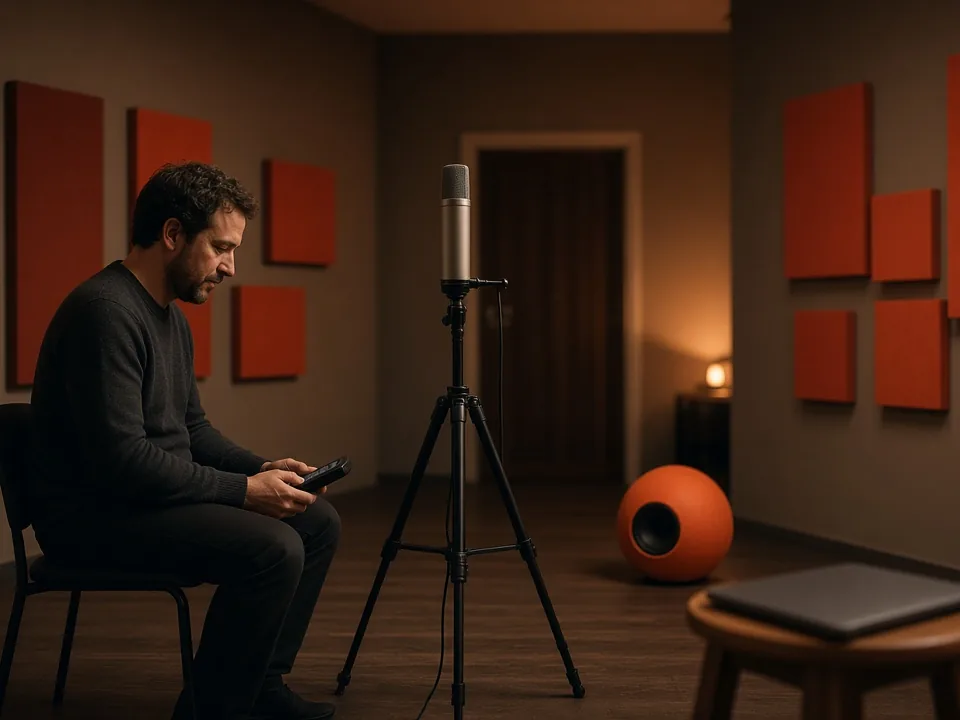
Proper reverberation time RT60 is the time it takes sound to decay by 60 dB after the source stops. In a small rehearsal room, a useful target is around 0.3 to 0.5 seconds.
Reliable measurements require a measurement microphone, a loudspeaker and software such as the free Room EQ Wizard. For a first impression, a phone app or even a hand clap can help: if the reverberation tail seems unusually long, the room needs treatment.
Empty spaces with hard walls, ceramic floors and tiles can easily exceed one second of reverberation, making rehearsals and recording difficult.
03 · ROOM ACOUSTICS
3. Step 3: install bass traps first
Here is the advice most people overlook: always start with bass traps, not decorative panels.
Low-frequency bass traps are absorbers commonly made from rock wool or dense open-cell foam. They are placed in vertical and ceiling-to-wall corners, where low-frequency problems are often particularly strong.
Why start here? Because bass is the hardest part of the spectrum to control and has a huge impact on mixing accuracy and rehearsal comfort. Treating mid and high frequencies first can leave a dull-sounding room with uncontrolled low frequencies.
Suggested starting quantity for a small room (20–40 m²):
- Four vertical corner traps, at least 60 cm wide and 1.2 m high.
- Two to four additional traps along wall-to-ceiling junctions.
04 · ROOM ACOUSTICS
4. Step 4: place absorption panels at reflection points
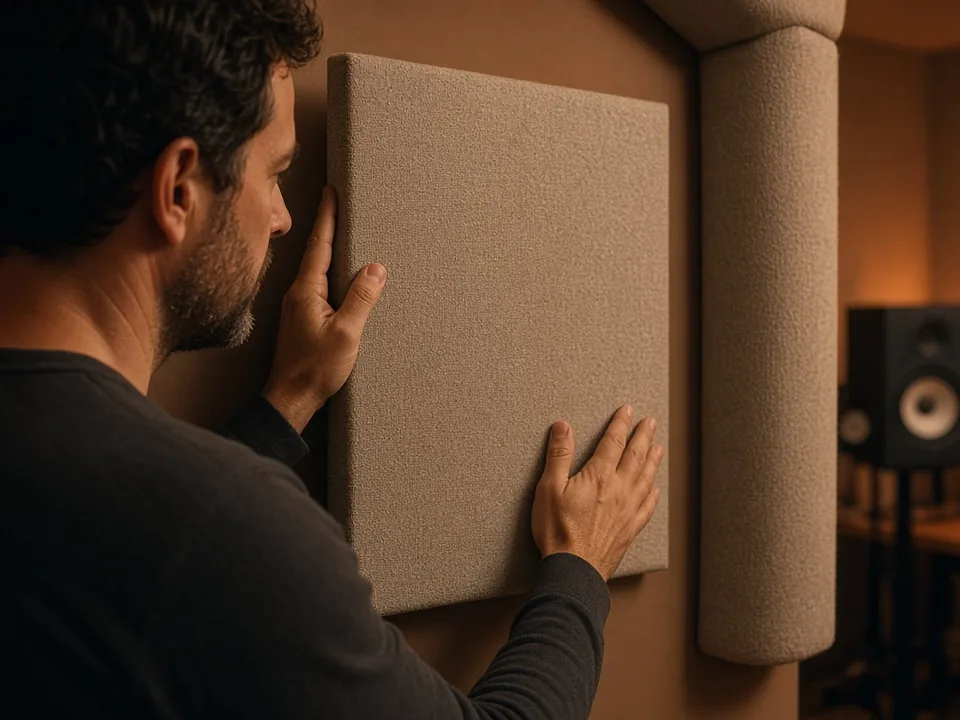
After dealing with bass, add absorption panels. These mainly control mid and high frequencies, reducing first reflections reaching listeners and shortening the overall reverberation time.
Where to position absorption panels
Key locations include:
- Side walls at listening height: find first-reflection points with the mirror trick, sliding a mirror along the wall while someone remains in the listening position.
- Rear wall: install a large absorber or a mixture of absorption and diffusion.
- Ceiling: a ceiling cloud above the central listening area is highly effective and often overlooked.
Materials that work
- Rock wool around 45–70 kg/m³, at least 5 cm thick and preferably 10 cm.
- High-density glass wool.
Acoustic foam versus rock wool: what does not work (despite being widely sold)
- Egg-crate packaging foam is practically useless. Even genuine thin acoustic foam panels work mainly in the mid-high range and do not adequately control bass.
- Decorative cork has little significant acoustic effect.
- Carpet on walls can modestly reduce highs but does not solve underlying acoustic problems.
05 · ROOM ACOUSTICS
5. Step 5: balance absorption with diffusion, including DIY options
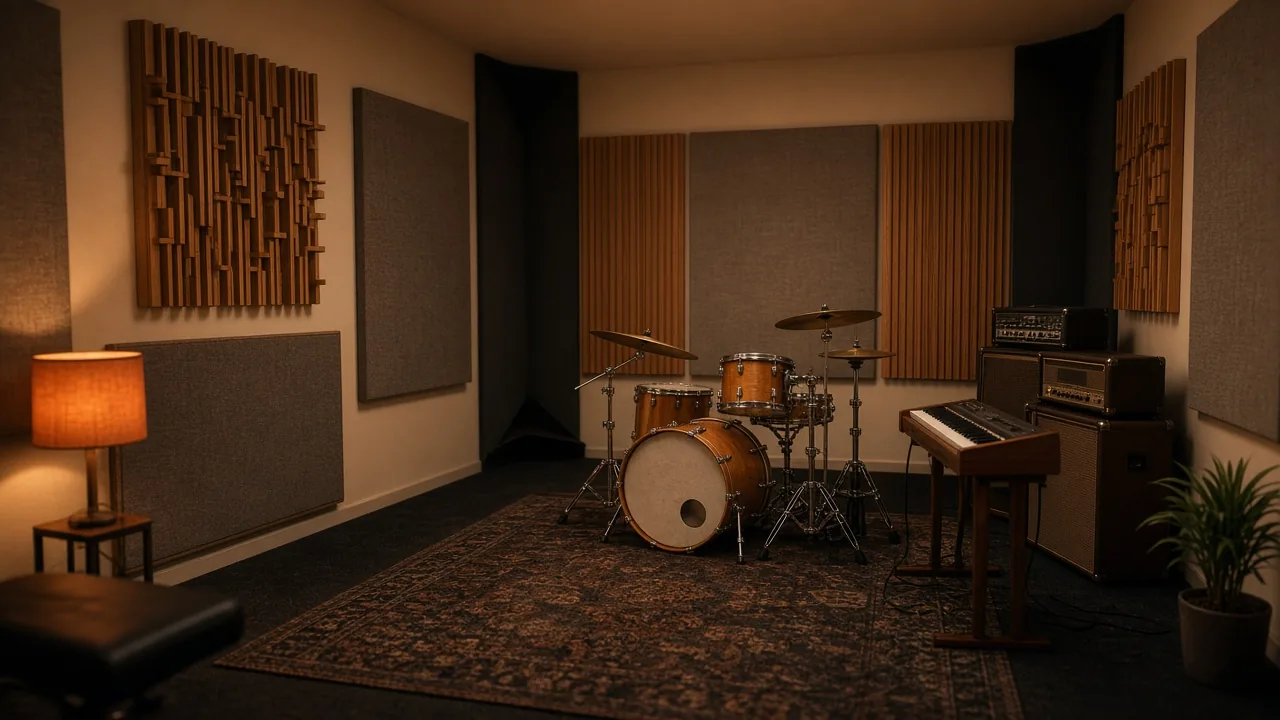
A completely absorptive room sounds lifeless and can be uncomfortable for rehearsal. Combine absorption with diffusion: irregular surfaces that scatter sound rather than simply absorbing it.
Shelves filled with equipment, cases and other irregular objects can provide some natural diffusion. If the room lacks these, consider purpose-built diffusers. Well-designed DIY wooden diffusers can work on rear walls and other areas away from critical reflection points.
Note: You may see a suggested balance of 70% absorption / 30% diffusion, but this is not a fixed rule. Measurements and how the room feels while playing should guide the final design.
06 · ROOM ACOUSTICS
6. Step 6: address soundproofing if neighbours can hear you
If sound also escapes the room—whether airborne music or structure-borne vibrations from drums and bass—the solution is completely different from acoustic treatment.
Proper Soundproofing a rehearsal room requires mass, decoupling and airtightness. Typical measures include:
- Fully sealing gaps around doors and windows.
- Installing a sound-rated door or two doors with an intervening lobby.
- Building a decoupled floating floor for drums and bass vibrations.
- Adding independent wall linings with mass and an air cavity.
Important: If the room is a business (hourly rehearsal facilities, music school or public studio), it also needs the relevant licence and compliance with Andalusian acoustic rules (Decree 50/2025) and local ordinances. This will often involve an acoustic assessment and, if amplified playback is used, a sound limiter-controller.
At RinconRock, we carry out pre-installation acoustic studies before any work, allowing us to specify appropriate solutions and avoid unnecessary building works. If a standard product does not suit the venue, our technical team can design custom solutions in our workshop, equipped for electronics, welding and machining.
07 · ROOM ACOUSTICS
7. Frequently asked questions about rehearsal room treatment
Do acoustic foam panels stop noise reaching the neighbours?
No. Foam and absorption panels improve the sound inside the room but do very little to stop it escaping. Effective soundproofing requires mass, structural decoupling and airtight sealing.
What reverberation time should a rehearsal room have?
For a small room, roughly 0.3–0.5 seconds is a useful starting point, ideally with an even response across frequencies. A room with short high-frequency decay but uncontrolled bass still sounds muddy.
Can I build my own absorption panels?
Yes. A wooden frame filled with rock wool rated around 45–70 kg/m³ and covered with breathable fabric works well. Wear gloves and a suitable mask when handling mineral wool, and check fire performance if the venue is open to the public.
How many bass traps do I need?
For a 20–40 m² room, start with a trap in each vertical corner and several at the wall-to-ceiling junctions. Then measure and add treatment where bass problems remain.
Do rehearsal rooms need a licence or acoustic report?
Commercial premises, music schools and studios open to the public require the relevant permissions and compliance with Decree 50/2025 and local ordinances, normally supported by an acoustic study. Private rooms must also respect noise limits affecting neighbours.
08 · ROOM ACOUSTICS
Conclusion: treat your rehearsal room in the right order
Proper rehearsal room acoustic treatment in Málaga Effective acoustic treatment need not be expensive when undertaken in the right sequence: corner bass traps first, absorption at reflection points second, then a considered amount of diffusion. Avoid decorative materials without real acoustic benefit, and do not confuse treatment with sound insulation. If the room is also a home studio, pay attention to audio cabling installation to avoid hum and ground loops.
For more complicated situations—noise escaping outdoors, difficult room geometry or a need for an acoustic certificate— RinconRock serves Málaga and Marbella with preliminary studies, our own equipment and tailored solutions. Contact us and we will explain exactly what you need, without unnecessary complications.
RINCONROCK RENTAL AV · RELATED RESOURCES
ROOM ACOUSTICS
If you have a rehearsal room or home studio in Málaga and are unhappy with its sound—or your neighbours have complained more than once—you need to understand the difference between soundproofing and acoustic treatment for a rehearsal room. These are two separate things, and confusing them can be an expensive mistake.
This guide explains how to approach rehearsal room acoustic treatment in Málaga step by step: what materials work, what wastes money and the order in which to proceed.
0.3–0.5 s
TARGET RT60 FOR A SMALL ROOM
6 STEPS
FROM DIAGNOSIS TO SOUNDPROOFING
45–70 kg/m³
ROCK WOOL DENSITY
01 · ROOM ACOUSTICS
1. Step 1: understand what you actually need
Before buying anything, identify the problem you are trying to solve. There is a difference between:
- Making your room sound better inside this is acoustic treatment.
- Preventing sound from entering or escaping this is sound insulation or soundproofing.
Proper acoustic treatment addresses how sound behaves within the room: it controls reflections, reduces reverberation time and tames the troublesome frequencies that make a room sound like a cave or a cardboard box.
Sound insulation, by contrast, involves mass, construction work and much larger budgets. If neighbours are complaining, you will need to tackle rehearsal room soundproofing as a separate project. RinconRock can help with that too, but adding panels to the walls is not the same thing.
02 · ROOM ACOUSTICS
2. Step 2: measure the room's reverberation time (RT60)
Proper reverberation time RT60 is the time it takes sound to decay by 60 dB after the source stops. In a small rehearsal room, a useful target is around 0.3 to 0.5 seconds.
Reliable measurements require a measurement microphone, a loudspeaker and software such as the free Room EQ Wizard. For a first impression, a phone app or even a hand clap can help: if the reverberation tail seems unusually long, the room needs treatment.
Empty spaces with hard walls, ceramic floors and tiles can easily exceed one second of reverberation, making rehearsals and recording difficult.
03 · ROOM ACOUSTICS
3. Step 3: install bass traps first
Here is the advice most people overlook: always start with bass traps, not decorative panels.
Low-frequency bass traps are absorbers commonly made from rock wool or dense open-cell foam. They are placed in vertical and ceiling-to-wall corners, where low-frequency problems are often particularly strong.
Why start here? Because bass is the hardest part of the spectrum to control and has a huge impact on mixing accuracy and rehearsal comfort. Treating mid and high frequencies first can leave a dull-sounding room with uncontrolled low frequencies.
Suggested starting quantity for a small room (20–40 m²):
- Four vertical corner traps, at least 60 cm wide and 1.2 m high.
- Two to four additional traps along wall-to-ceiling junctions.
04 · ROOM ACOUSTICS
4. Step 4: place absorption panels at reflection points
After dealing with bass, add absorption panels. These mainly control mid and high frequencies, reducing first reflections reaching listeners and shortening the overall reverberation time.
Where to position absorption panels
Key locations include:
- Side walls at listening height: find first-reflection points with the mirror trick, sliding a mirror along the wall while someone remains in the listening position.
- Rear wall: install a large absorber or a mixture of absorption and diffusion.
- Ceiling: a ceiling cloud above the central listening area is highly effective and often overlooked.
Materials that work
- Rock wool around 45–70 kg/m³, at least 5 cm thick and preferably 10 cm.
- High-density glass wool.
Acoustic foam versus rock wool: what does not work (despite being widely sold)
- Egg-crate packaging foam is practically useless. Even genuine thin acoustic foam panels work mainly in the mid-high range and do not adequately control bass.
- Decorative cork has little significant acoustic effect.
- Carpet on walls can modestly reduce highs but does not solve underlying acoustic problems.
05 · ROOM ACOUSTICS
5. Step 5: balance absorption with diffusion, including DIY options
A completely absorptive room sounds lifeless and can be uncomfortable for rehearsal. Combine absorption with diffusion: irregular surfaces that scatter sound rather than simply absorbing it.
Shelves filled with equipment, cases and other irregular objects can provide some natural diffusion. If the room lacks these, consider purpose-built diffusers. Well-designed DIY wooden diffusers can work on rear walls and other areas away from critical reflection points.
Note: You may see a suggested balance of 70% absorption / 30% diffusion, but this is not a fixed rule. Measurements and how the room feels while playing should guide the final design.
06 · ROOM ACOUSTICS
6. Step 6: address soundproofing if neighbours can hear you
If sound also escapes the room—whether airborne music or structure-borne vibrations from drums and bass—the solution is completely different from acoustic treatment.
Proper Soundproofing a rehearsal room requires mass, decoupling and airtightness. Typical measures include:
- Fully sealing gaps around doors and windows.
- Installing a sound-rated door or two doors with an intervening lobby.
- Building a decoupled floating floor for drums and bass vibrations.
- Adding independent wall linings with mass and an air cavity.
Important: If the room is a business (hourly rehearsal facilities, music school or public studio), it also needs the relevant licence and compliance with Andalusian acoustic rules (Decree 50/2025) and local ordinances. This will often involve an acoustic assessment and, if amplified playback is used, a sound limiter-controller.
At RinconRock, we carry out pre-installation acoustic studies before any work, allowing us to specify appropriate solutions and avoid unnecessary building works. If a standard product does not suit the venue, our technical team can design custom solutions in our workshop, equipped for electronics, welding and machining.
07 · ROOM ACOUSTICS
7. Frequently asked questions about rehearsal room treatment
Do acoustic foam panels stop noise reaching the neighbours?
No. Foam and absorption panels improve the sound inside the room but do very little to stop it escaping. Effective soundproofing requires mass, structural decoupling and airtight sealing.
What reverberation time should a rehearsal room have?
For a small room, roughly 0.3–0.5 seconds is a useful starting point, ideally with an even response across frequencies. A room with short high-frequency decay but uncontrolled bass still sounds muddy.
Can I build my own absorption panels?
Yes. A wooden frame filled with rock wool rated around 45–70 kg/m³ and covered with breathable fabric works well. Wear gloves and a suitable mask when handling mineral wool, and check fire performance if the venue is open to the public.
How many bass traps do I need?
For a 20–40 m² room, start with a trap in each vertical corner and several at the wall-to-ceiling junctions. Then measure and add treatment where bass problems remain.
Do rehearsal rooms need a licence or acoustic report?
Commercial premises, music schools and studios open to the public require the relevant permissions and compliance with Decree 50/2025 and local ordinances, normally supported by an acoustic study. Private rooms must also respect noise limits affecting neighbours.
08 · ROOM ACOUSTICS
Conclusion: treat your rehearsal room in the right order
Proper rehearsal room acoustic treatment in Málaga Effective acoustic treatment need not be expensive when undertaken in the right sequence: corner bass traps first, absorption at reflection points second, then a considered amount of diffusion. Avoid decorative materials without real acoustic benefit, and do not confuse treatment with sound insulation. If the room is also a home studio, pay attention to audio cabling installation to avoid hum and ground loops.
For more complicated situations—noise escaping outdoors, difficult room geometry or a need for an acoustic certificate— RinconRock serves Málaga and Marbella with preliminary studies, our own equipment and tailored solutions. Contact us and we will explain exactly what you need, without unnecessary complications.
RINCONROCK RENTAL AV · RELATED RESOURCES
Rehearsal Room Acoustic Treatment in Málaga: What Works and What to Avoid