SOUND LIMITERS AND NOISE REGULATIONS
If you operate a bar, pub or nightclub in Andalusia and play music, sooner or later the authorities may check your installation. An approved sound limiter in Andalusia can be a legal requirement, and compliance can determine whether your premises retain their licence or face serious penalties.
There is a great deal of confusion about which devices qualify, how to install them and, most importantly, how to achieve the best sound without sacrificing compliance. This guide addresses those questions.
Here is what you need to know: Andalusian acoustic regulations, equipment selection, installation requirements and how to optimise the allowed sound level without sacrificing sound quality.
DECREE 50/2025
ANDALUSIAN REGULATIONS
6 STEPS
FROM ASSESSMENT TO CERTIFICATION
3 ESSENTIALS
APPROVAL · CALIBRATION · SEALING
01 · SOUND LIMITERS AND NOISE REGULATIONS
1. What is an approved sound limiter and why might you need one?
An approved sound limiter is an electronic device installed in your venue's signal chain that restricts output when sound exceeds an officially established threshold. It is not just an equaliser or compressor: a limiter-recorder also maintains a log of sound levels and operating conditions.
Those records matter. Inspectors may request stored data to check compliance with permitted sound levels. Without valid records, or with a device that does not meet the applicable requirements, a venue is in a weaker position when facing noise complaints.
When is one mandatory?
- When required by your operating licence
- Where the venue uses music playback, DJs or amplified live performances and falls within the regulated categories
- When specified following complaints or enforcement action
- In many cases, as a condition of a new premises licence
Requirements in Andalusia are increasingly specific. Installing a compliant limiter is not merely an expense: it helps protect the business.
02 · SOUND LIMITERS AND NOISE REGULATIONS
2. Andalusian acoustic law: Decree 50/2025 and your music licence
The acoustic regulations in Andalusia are mainly defined by Decree 50/2025 of 24 February, which establishes regulations for preserving acoustic quality in Andalusia and replaced Decree 6/2012 in March 2025. Nationally, Noise Law 37/2003 provides the general framework, while regional rules define important requirements for individual venues.
Permitted sound levels by venue type
Maximum levels differ according to the use, location and licence. As a general guide:
- Bars and restaurants without live music: typically less demanding restrictions than amplified music venues
- Pubs and bars with music: the licence and acoustic report determine the internal maximum level, considering the proven sound insulation
- Nightclubs and concert venues: may have different limits depending on their certified insulation
- Terraces and outdoor seating: outdoor music needs express municipal authorisation, as explained in our guide to terrace sound systems in Málaga
Important: Your exact sound limit is determined by your operating licence or municipal decision. There is no single limit applying to every premises in Andalusia: the municipality, acoustic zone and building use all matter.
The role of local councils in Málaga and the Costa del Sol
In Málaga city and towns such as Marbella, Estepona and Fuengirola, compliance receives particular scrutiny because nightlife often takes place close to residential areas.
During inspections, municipal technicians may measure noise on site. An incorrectly installed, calibrated or approved limiter can result in enforcement action even when the actual sound level was not especially high.
03 · SOUND LIMITERS AND NOISE REGULATIONS
3. Choosing a limiter-recorder in Málaga and Andalusia
Not every device sold as a sound limiter is acceptable. Equipment must satisfy the technical and administrative requirements applicable in Andalusia.
Essential technical requirements
An A compliant limiter-recorder for Andalusia should provide:
- Approved or compliant limiter equipment: evidence that the device meets the applicable requirements
- Logging capability: sound level data stored with timestamps
- Tamper protection and sealing: provision for an authorised installer to seal the device against configuration changes
- Documented calibration: setting the limit according to the conditions in the venue licence
- A calibrated measurement microphone: the control microphone must meet requirements and be installed correctly
What to avoid
Some installers offer cheap generic devices that are not compliant or lack appropriate logging. They may appear to work but offer little protection during an inspection.
Tip: Before booking, confirm the firm is authorised to install limiter-recorders and can supply the required technical documentation.

04 · SOUND LIMITERS AND NOISE REGULATIONS
4. Installation process step by step
Installing a sound limiter in a bar or entertainment venue is specialist work. It requires audio engineering skills, knowledge of the rules and appropriate administrative authorisation.
Step 1. Initial venue assessment
Before installation, assess the existing sound system, how the premises are used and typical operating levels. This determines the best device and suitable control-microphone location.
Good assessment prevents problems later. At RinconRock, this initial survey is part of every project, helping us specify a solution suited to the venue and offer competitive pricing.
Step 2. Select and supply compliant equipment
The installer selects a limiter-recorder to suit the venue and the licence requirements. The device must meet applicable standards and have proper technical documentation.
Step 3. Install it in the audio chain
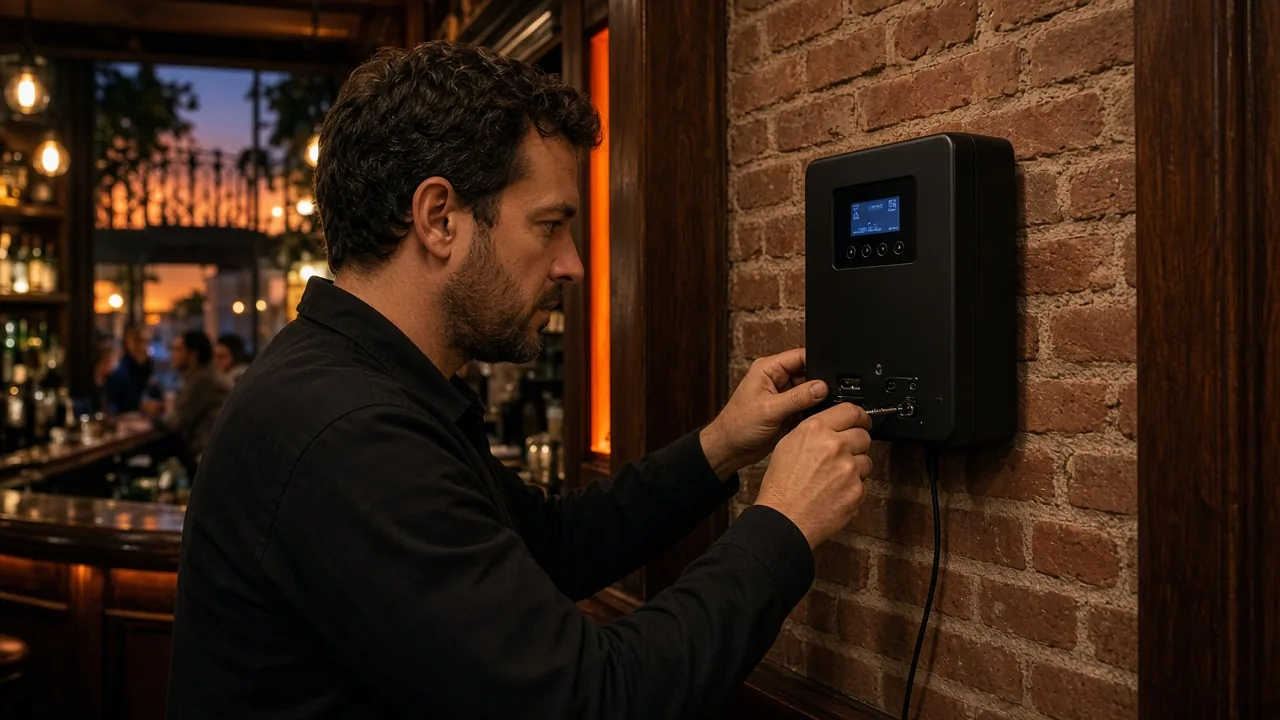
The limiter is integrated between the source (mixer, player, etc.) and the amplifiers. Its position matters: a poor installation might allow it to be bypassed accidentally or leave some of the system uncontrolled. Start with a properly planned audio cabling installation.
Step 4. Calibrate and configure the threshold
This is one of the most critical stages. The technician sets the threshold to comply with the maximum level permitted under the licence. Calibration should use appropriate certified instrumentation and be documented.
Step 5. Seal and hand over documentation
After calibration, the equipment is sealed against tampering and the venue owner receives the documents that may be requested at an inspection.
Step 6. Obtain an acoustic certificate
In many cases, the installation must also include an acoustic compliance certificate for the premises issued by a competent professional following on-site acoustic measurements.
05 · SOUND LIMITERS AND NOISE REGULATIONS
5. Making the most of the permitted sound level
This is what worries venue owners most: How can the music sound good if the volume is restricted?
Perceived loudness is not determined by decibels alone. Speaker distribution, equipment choice and system configuration also matter.
Optimising the sound system
A properly designed system can sound louder and clearer without increasing the regulated level. Key factors include:
- Correct speaker distribution: delivering appropriate sound close to listeners instead of excessive volume from one position
- Even coverage: preventing dead spots and excessively loud areas
- Professional equalisation: controlling frequencies that dominate measurements without enhancing the listening experience
- Feedback suppression: feedback wastes headroom and often leads operators to increase volume unnecessarily
Positioning the control microphone correctly
The microphone's position affects the effective limiting behaviour. A competent technician selects a representative point that does not unnecessarily penalise the system's overall level.
Common mistake: If the microphone is poorly located—for example, much too close to a loudspeaker—the limiter may intervene earlier than necessary and prevent the venue from making full use of its permitted level.
Room acoustics
Appropriate interior acoustic treatment also makes a difference. Excessive reverberation causes energy to build up and can drive the meter higher even when the direct sound is moderate. Well-placed absorption can improve usable clarity without changing the legal threshold.
06 · SOUND LIMITERS AND NOISE REGULATIONS
6. Acoustic certificates: what they are and when you need one
Appropriate acoustic compliance certificate for the premises An acoustic certificate is a technical document demonstrating that the premises comply with relevant sound insulation and noise emission requirements.
When is one mandatory?
- When applying for or renewing an operating licence in many municipalities
- Following a noise complaint
- When expressly requested by inspectors
- For newly opened premises offering musical activities
The certificate must be prepared by a competent professional—often an engineer or architect with acoustic expertise—using measurements taken under the applicable standards.
RinconRock can arrange both limiter installation and the acoustic certificate, simplifying the process for the venue owner and keeping the technical paperwork consistent with the actual installation.
07 · SOUND LIMITERS AND NOISE REGULATIONS
7. Common mistakes that could jeopardise your licence
Our experience installing limiters in Málaga and Costa del Sol premises has highlighted recurring errors:
- Buying a limiter without checking compliance: not every product is acceptable to the Andalusian authorities
- Installing the device without an authorised company: installation must be supported by official documentation
- Incorrect threshold calibration: an improperly calibrated limiter does not offer protection simply because it has been fitted
- Ignoring the control microphone's position: a badly positioned microphone may make the system ineffective or unnecessarily restrictive
- Failing to obtain a required acoustic certificate: the limiter installation and certificate are separate requirements, and both may be needed
- Not checking the security seal periodically: a broken seal at inspection can raise concerns about unauthorised changes
08 · SOUND LIMITERS AND NOISE REGULATIONS
8. Frequently asked questions about approved acoustic limiters
Does my bar legally need an approved sound limiter?
It depends on the activity and operating licence. Andalusian Decree 50/2025 requires limiter-controllers for premises with sound reproduction or amplification equipment whose emission may exceed 85 decibels, according to the original guidance. The definitive reference for your premises is its licence and municipal decision.
Can I install the limiter-recorder myself?
It is not advisable and may not meet the required administrative conditions. Installation, calibration and sealing must be evidenced by an appropriately authorised company. A self-installed unit may not be accepted during an inspection.
Why does my limiter cut the music earlier than expected?
Common causes are a badly positioned measurement microphone, excessive bass or high room reverberation. Reviewing speaker distribution, EQ and acoustics can improve usable sound without altering the authorised threshold.
Are the limiter and acoustic certificate the same thing?
No. The limiter controls and logs the system's level. The acoustic certificate documents, through measurements by a qualified technician, that sound insulation and noise limits are met. Many venues need both.
What changes for limiters under Decree 50/2025?
The decree replaced Decree 6/2012 on 24 March 2025. Its Technical Instruction 6 updates limiter-controller requirements, becoming applicable one year after the decree entered into force. If your unit predates these changes, ask an installer to review its compliance.
09 · SOUND LIMITERS AND NOISE REGULATIONS
Conclusion: comply with regulations without sacrificing sound quality
Meeting Andalusian acoustic requirements need not mean giving up good sound at your venue. With a approved sound limiter in Andalusia properly installed, calibrated and documented limiter, you can protect your licence and optimise the guest experience within permitted limits. Many estates and wedding venues face similar requirements, as discussed in our wedding sound checklist.
The key is to work with professionals who understand both audio engineering and the legal requirements of your municipality. Getting it right from the start avoids penalties, complaints and remedial costs.
At RinconRock we are an authorised installer of limiter-recorders in Málaga and throughout the Costa del Sol. We assess the venue, supply and fit suitable compliant equipment, calibrate and seal it, and arrange an acoustic certificate when needed. It is one coordinated service, without unnecessary intermediaries.
Unsure what your venue needs? Contact us for a clear assessment based on your circumstances.
Would you like us to review your situation? Contact RinconRock for advice without obligation.
RINCONROCK RENTAL AV · RELATED RESOURCES
SOUND LIMITERS AND NOISE REGULATIONS
If you operate a bar, pub or nightclub in Andalusia and play music, sooner or later the authorities may check your installation. An approved sound limiter in Andalusia can be a legal requirement, and compliance can determine whether your premises retain their licence or face serious penalties.
There is a great deal of confusion about which devices qualify, how to install them and, most importantly, how to achieve the best sound without sacrificing compliance. This guide addresses those questions.
Here is what you need to know: Andalusian acoustic regulations, equipment selection, installation requirements and how to optimise the allowed sound level without sacrificing sound quality.
DECREE 50/2025
ANDALUSIAN REGULATIONS
6 STEPS
FROM ASSESSMENT TO CERTIFICATION
3 ESSENTIALS
APPROVAL · CALIBRATION · SEALING
01 · SOUND LIMITERS AND NOISE REGULATIONS
1. What is an approved sound limiter and why might you need one?
An approved sound limiter is an electronic device installed in your venue's signal chain that restricts output when sound exceeds an officially established threshold. It is not just an equaliser or compressor: a limiter-recorder also maintains a log of sound levels and operating conditions.
Those records matter. Inspectors may request stored data to check compliance with permitted sound levels. Without valid records, or with a device that does not meet the applicable requirements, a venue is in a weaker position when facing noise complaints.
When is one mandatory?
- When required by your operating licence
- Where the venue uses music playback, DJs or amplified live performances and falls within the regulated categories
- When specified following complaints or enforcement action
- In many cases, as a condition of a new premises licence
Requirements in Andalusia are increasingly specific. Installing a compliant limiter is not merely an expense: it helps protect the business.
02 · SOUND LIMITERS AND NOISE REGULATIONS
2. Andalusian acoustic law: Decree 50/2025 and your music licence
The acoustic regulations in Andalusia are mainly defined by Decree 50/2025 of 24 February, which establishes regulations for preserving acoustic quality in Andalusia and replaced Decree 6/2012 in March 2025. Nationally, Noise Law 37/2003 provides the general framework, while regional rules define important requirements for individual venues.
Permitted sound levels by venue type
Maximum levels differ according to the use, location and licence. As a general guide:
- Bars and restaurants without live music: typically less demanding restrictions than amplified music venues
- Pubs and bars with music: the licence and acoustic report determine the internal maximum level, considering the proven sound insulation
- Nightclubs and concert venues: may have different limits depending on their certified insulation
- Terraces and outdoor seating: outdoor music needs express municipal authorisation, as explained in our guide to terrace sound systems in Málaga
Important: Your exact sound limit is determined by your operating licence or municipal decision. There is no single limit applying to every premises in Andalusia: the municipality, acoustic zone and building use all matter.
The role of local councils in Málaga and the Costa del Sol
In Málaga city and towns such as Marbella, Estepona and Fuengirola, compliance receives particular scrutiny because nightlife often takes place close to residential areas.
During inspections, municipal technicians may measure noise on site. An incorrectly installed, calibrated or approved limiter can result in enforcement action even when the actual sound level was not especially high.
03 · SOUND LIMITERS AND NOISE REGULATIONS
3. Choosing a limiter-recorder in Málaga and Andalusia
Not every device sold as a sound limiter is acceptable. Equipment must satisfy the technical and administrative requirements applicable in Andalusia.
Essential technical requirements
An A compliant limiter-recorder for Andalusia should provide:
- Approved or compliant limiter equipment: evidence that the device meets the applicable requirements
- Logging capability: sound level data stored with timestamps
- Tamper protection and sealing: provision for an authorised installer to seal the device against configuration changes
- Documented calibration: setting the limit according to the conditions in the venue licence
- A calibrated measurement microphone: the control microphone must meet requirements and be installed correctly
What to avoid
Some installers offer cheap generic devices that are not compliant or lack appropriate logging. They may appear to work but offer little protection during an inspection.
Tip: Before booking, confirm the firm is authorised to install limiter-recorders and can supply the required technical documentation.
04 · SOUND LIMITERS AND NOISE REGULATIONS
4. Installation process step by step
Installing a sound limiter in a bar or entertainment venue is specialist work. It requires audio engineering skills, knowledge of the rules and appropriate administrative authorisation.
Step 1. Initial venue assessment
Before installation, assess the existing sound system, how the premises are used and typical operating levels. This determines the best device and suitable control-microphone location.
Good assessment prevents problems later. At RinconRock, this initial survey is part of every project, helping us specify a solution suited to the venue and offer competitive pricing.
Step 2. Select and supply compliant equipment
The installer selects a limiter-recorder to suit the venue and the licence requirements. The device must meet applicable standards and have proper technical documentation.
Step 3. Install it in the audio chain
The limiter is integrated between the source (mixer, player, etc.) and the amplifiers. Its position matters: a poor installation might allow it to be bypassed accidentally or leave some of the system uncontrolled. Start with a properly planned audio cabling installation.
Step 4. Calibrate and configure the threshold
This is one of the most critical stages. The technician sets the threshold to comply with the maximum level permitted under the licence. Calibration should use appropriate certified instrumentation and be documented.
Step 5. Seal and hand over documentation
After calibration, the equipment is sealed against tampering and the venue owner receives the documents that may be requested at an inspection.
Step 6. Obtain an acoustic certificate
In many cases, the installation must also include an acoustic compliance certificate for the premises issued by a competent professional following on-site acoustic measurements.
05 · SOUND LIMITERS AND NOISE REGULATIONS
5. Making the most of the permitted sound level
This is what worries venue owners most: How can the music sound good if the volume is restricted?
Perceived loudness is not determined by decibels alone. Speaker distribution, equipment choice and system configuration also matter.
Optimising the sound system
A properly designed system can sound louder and clearer without increasing the regulated level. Key factors include:
- Correct speaker distribution: delivering appropriate sound close to listeners instead of excessive volume from one position
- Even coverage: preventing dead spots and excessively loud areas
- Professional equalisation: controlling frequencies that dominate measurements without enhancing the listening experience
- Feedback suppression: feedback wastes headroom and often leads operators to increase volume unnecessarily
Positioning the control microphone correctly
The microphone's position affects the effective limiting behaviour. A competent technician selects a representative point that does not unnecessarily penalise the system's overall level.
Common mistake: If the microphone is poorly located—for example, much too close to a loudspeaker—the limiter may intervene earlier than necessary and prevent the venue from making full use of its permitted level.
Room acoustics
Appropriate interior acoustic treatment also makes a difference. Excessive reverberation causes energy to build up and can drive the meter higher even when the direct sound is moderate. Well-placed absorption can improve usable clarity without changing the legal threshold.
06 · SOUND LIMITERS AND NOISE REGULATIONS
6. Acoustic certificates: what they are and when you need one
Appropriate acoustic compliance certificate for the premises An acoustic certificate is a technical document demonstrating that the premises comply with relevant sound insulation and noise emission requirements.
When is one mandatory?
- When applying for or renewing an operating licence in many municipalities
- Following a noise complaint
- When expressly requested by inspectors
- For newly opened premises offering musical activities
The certificate must be prepared by a competent professional—often an engineer or architect with acoustic expertise—using measurements taken under the applicable standards.
RinconRock can arrange both limiter installation and the acoustic certificate, simplifying the process for the venue owner and keeping the technical paperwork consistent with the actual installation.
07 · SOUND LIMITERS AND NOISE REGULATIONS
7. Common mistakes that could jeopardise your licence
Our experience installing limiters in Málaga and Costa del Sol premises has highlighted recurring errors:
- Buying a limiter without checking compliance: not every product is acceptable to the Andalusian authorities
- Installing the device without an authorised company: installation must be supported by official documentation
- Incorrect threshold calibration: an improperly calibrated limiter does not offer protection simply because it has been fitted
- Ignoring the control microphone's position: a badly positioned microphone may make the system ineffective or unnecessarily restrictive
- Failing to obtain a required acoustic certificate: the limiter installation and certificate are separate requirements, and both may be needed
- Not checking the security seal periodically: a broken seal at inspection can raise concerns about unauthorised changes
08 · SOUND LIMITERS AND NOISE REGULATIONS
8. Frequently asked questions about approved acoustic limiters
Does my bar legally need an approved sound limiter?
It depends on the activity and operating licence. Andalusian Decree 50/2025 requires limiter-controllers for premises with sound reproduction or amplification equipment whose emission may exceed 85 decibels, according to the original guidance. The definitive reference for your premises is its licence and municipal decision.
Can I install the limiter-recorder myself?
It is not advisable and may not meet the required administrative conditions. Installation, calibration and sealing must be evidenced by an appropriately authorised company. A self-installed unit may not be accepted during an inspection.
Why does my limiter cut the music earlier than expected?
Common causes are a badly positioned measurement microphone, excessive bass or high room reverberation. Reviewing speaker distribution, EQ and acoustics can improve usable sound without altering the authorised threshold.
Are the limiter and acoustic certificate the same thing?
No. The limiter controls and logs the system's level. The acoustic certificate documents, through measurements by a qualified technician, that sound insulation and noise limits are met. Many venues need both.
What changes for limiters under Decree 50/2025?
The decree replaced Decree 6/2012 on 24 March 2025. Its Technical Instruction 6 updates limiter-controller requirements, becoming applicable one year after the decree entered into force. If your unit predates these changes, ask an installer to review its compliance.
09 · SOUND LIMITERS AND NOISE REGULATIONS
Conclusion: comply with regulations without sacrificing sound quality
Meeting Andalusian acoustic requirements need not mean giving up good sound at your venue. With a approved sound limiter in Andalusia properly installed, calibrated and documented limiter, you can protect your licence and optimise the guest experience within permitted limits. Many estates and wedding venues face similar requirements, as discussed in our wedding sound checklist.
The key is to work with professionals who understand both audio engineering and the legal requirements of your municipality. Getting it right from the start avoids penalties, complaints and remedial costs.
At RinconRock we are an authorised installer of limiter-recorders in Málaga and throughout the Costa del Sol. We assess the venue, supply and fit suitable compliant equipment, calibrate and seal it, and arrange an acoustic certificate when needed. It is one coordinated service, without unnecessary intermediaries.
Unsure what your venue needs? Contact us for a clear assessment based on your circumstances.
Would you like us to review your situation? Contact RinconRock for advice without obligation.
RINCONROCK RENTAL AV · RELATED RESOURCES
Certified Sound Limiters in Andalusia: A Complete Guide for Bars and Hospitality Venues