OUTDOOR SOUND
Providing sound systems for terraces in Málaga comes with specific challenges. Levante winds, homes only a few metres away and increasingly demanding noise regulations turn what appears to be a simple project—playing music on a terrace—into a serious technical task.
This guide is for bar, restaurant and rooftop-hotel owners who want high-quality music outdoors without fines, complaints or technical problems. Here is what matters.
13:00–24:00
MAXIMUM PERMITTED HOURS IN CERTAIN COASTAL TOWNS
IP55+
OUTDOOR LOUDSPEAKERS
5 STEPS
FROM SURVEY TO CALIBRATION
01 · OUTDOOR SOUND
1. Step 1: assess the space before buying anything
The most common mistake is choosing loudspeakers before analysing the site. Sound behaves very differently outdoors than indoors.
Before deciding, answer these questions:
- How large is the terrace or rooftop in square metres?
- Are there reflective surfaces such as walls, ceilings or tiled floors?
- Is the area exposed to wind or protected from it?
- Are there residential properties within 20–30 metres?
- What are the operating hours: daytime, night-time or both?
Tip: Each factor affects the equipment type, required power and installation strategy. Without a site assessment, the design is little more than guesswork.
02 · OUTDOOR SOUND
2. Step 2: choose weather-resistant outdoor loudspeakers
Not all bar terrace loudspeakers serve the same purpose. Coastal conditions around Málaga introduce another challenge: salt and humidity can rapidly damage equipment not designed for outdoor use .
Speaker types for different spaces
Column loudspeakers (compact line arrays)
A good option for large rooftops. They control vertical dispersion, concentrating sound on listeners and reducing energy projected upwards and further afield, helping minimise disturbance to neighbours.
Surface-mounted loudspeakers
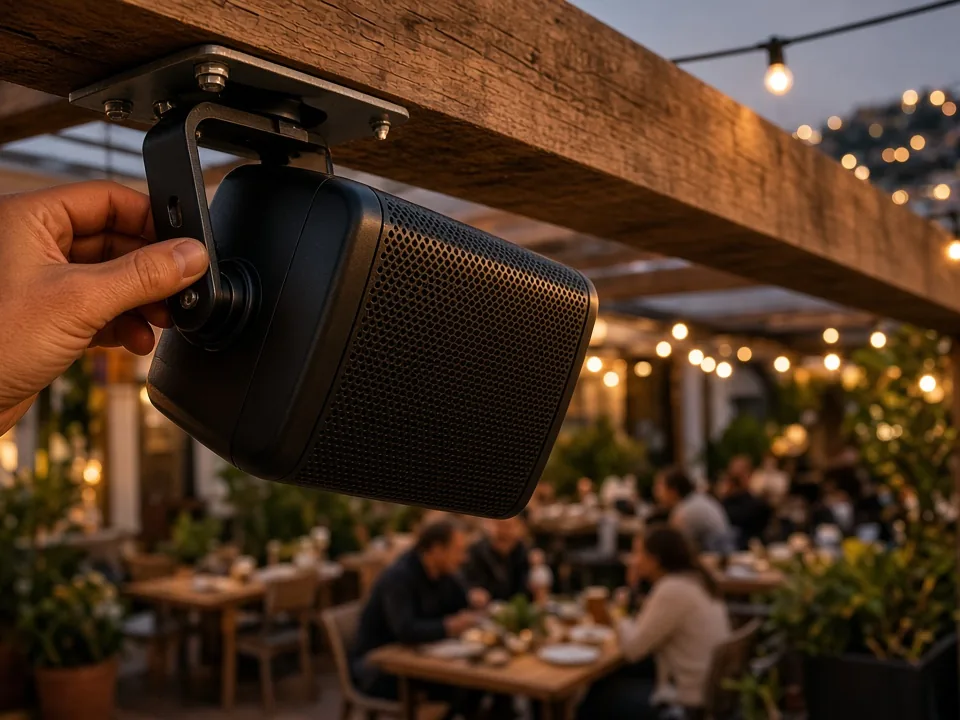
Ideal for smaller terraces or areas with low ceilings. They can be fixed to walls or structures and aimed at specific zones without wasting acoustic output.
Ground- or furniture-integrated loudspeakers
An attractive solution for premium installations, common in luxury hotels on the Costa del Sol. Sound reaches listeners from a lower height and at lower levels, potentially reducing spill beyond the site.
What to look for in an outdoor loudspeaker
- IP55 or higher protection rating (resistance to dust and water)
- UV- and salt-resistant materials (marine-grade plastics and stainless steel)
- Balanced frequency response for background music; most terraces do not need a subwoofer
03 · OUTDOOR SOUND
3. Step 3: manage wind as an engineering factor
Sound on rooftops and elevated terraces faces an often overlooked issue: wind. Around Málaga, Levante and Terral winds can carry sound and significantly change coverage, especially on exposed rooftop terraces.
Ways to minimise wind-related problems:
- Consider the prevailing wind when aiming loudspeakers. Sound travels further downwind. Avoid directing loudspeakers towards nearby homes or placing those homes directly downwind where possible. Always aim sound towards customers, not residential façades.
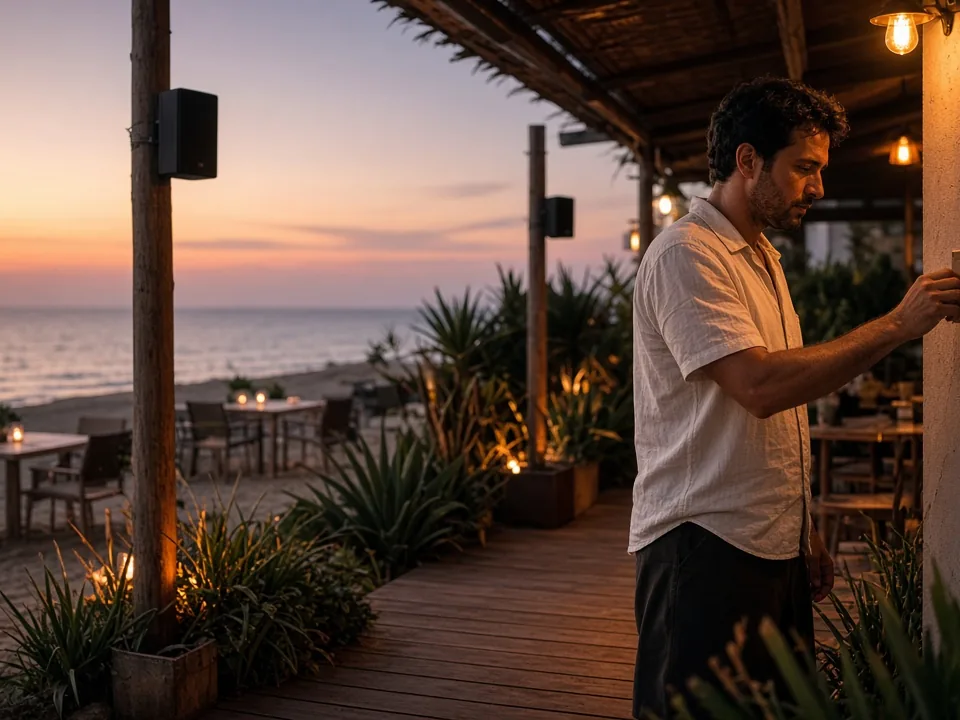
- Install loudspeakers at a relatively low height, aimed downwards towards the listening area. The closer they are to guests and the more sheltered they are from wind, the better the coverage.
- Distribute several lower-power loudspeakers instead of relying on one or two powerful boxes. This improves consistency and reduces the overall level needed.
- Avoid outdoor subwoofers unless they form part of a properly measured acoustic design. Low frequencies travel widely and are a major source of neighbour complaints.
04 · OUTDOOR SOUND
4. Step 4: comply with terrace noise rules in Andalusia and Málaga
Providing Terrace music regulations in Málaga combine several layers of law: regional Law 7/2007 on Integrated Environmental Quality Management, the Andalusian acoustic regulation (Decree 50/2025) and Decree 155/2018 on public entertainment, plus municipal noise ordinances and local planning rules. Ignoring these requirements is not a workable option.
Before installing: In Andalusia, the general rule is that sound reproduction and amplification equipment can only be used inside enclosed, roofed areas of the establishment. Music on terraces, pavement seating and private outdoor areas such as rooftops requires express municipal authorisation. Such authorisation may be limited to four months per year, or six months in certain tourist coastal municipalities following Decree 251/2023. It may not start before 15:00—or 13:00 in those municipalities—and cannot continue beyond midnight. In Málaga city, planning rules generally prohibit amplified sound equipment on terraces.
Outdoor noise limits (reference values)
| Period | Noise transmitted outdoors by an activity in a residential area |
|---|---|
| Day (07:00–19:00) | 55 dB(A) |
| Evening (19:00–23:00) | 55 dB(A) |
| Night (23:00–07:00) | 45 dB(A) |
Reference values from Spanish Royal Decree 1367/2007 for residential areas. Limits may differ depending on municipal acoustic zoning, special acoustic zones and your specific authorisation. Always consult a qualified professional.
Tools for sound level control
Sound on Outdoor volume control should not depend on whichever member of staff is on duty. Professional solutions include:
- Approved sound limiters: devices which automatically constrain output above the configured threshold and record operating information. Municipal terrace permits often impose this kind of technical requirement.
- DSP processors with zone control: Allow separate volume adjustment for indoor areas, terraces and rooftops from a central panel or app.
- Continuous sound level meters: monitor sound pressure levels in real time and generate records that can help document operation in case of a complaint.
RinconRock is an authorised installer of sound limiter-recorders in Málaga and along the Costa del Sol. If your venue faces neighbour complaints or municipal requirements, we can carry out the preliminary acoustic study and complete installation.

05 · OUTDOOR SOUND
5. Step 5: plan the installation properly
A good installation of outdoor loudspeakers must be engineered, not improvised. Key steps include:
- A preliminary acoustic study of the area (level measurements, reflection analysis and identification of problem points)
- System design using acoustic prediction software to check coverage before installation
- Installation of protected cabling designed for moisture and UV exposure
- System adjustment and calibration with real measurements after installation
- Technical documentation for possible administrative inspections
Important: Skipping any step creates risks: technical (poor sound), financial (damaged equipment) and legal (sanctions for exceeding sound limits).
06 · OUTDOOR SOUND
6. Frequently asked questions about terrace sound systems
Can I play music on my bar terrace in Málaga?
Only with express municipal authorisation. Andalusian rules generally restrict amplified sound to enclosed, roofed areas, with limited exceptions for terraces and outdoor seating. Authorisations may cover up to four months a year, or six in certain tourist coastal towns, with permitted hours no earlier than 15:00—or 13:00 in those towns—and ending by midnight. The general rule in Málaga city is prohibition.
Does a private rooftop count as a terrace?
Yes. Restrictions can also cover an establishment's private open or uncovered areas. Málaga planning rules may also treat awnings, temporary enclosures and covered courtyards as outdoor spaces.
What noise level is allowed at night?
As a reference, noise transmitted by an activity to a residential outdoor area should not exceed 45 dB(A) at night and 55 dB(A) by day or evening under Royal Decree 1367/2007. Local limits can differ by acoustic zone.
How many loudspeakers does a terrace need?
It depends on area, shape and obstacles. Several smaller loudspeakers operating at lower levels usually provide better coverage than two large ones. Acoustic prediction should be used where possible before installation.
Is a sound limiter required on a terrace?
Where music is authorised, municipal permits must set technical and timing conditions and often require a sound limiter-controller. Even where not mandatory, it can help manage levels and document compliance.
07 · OUTDOOR SOUND
Conclusion: terrace sound in Málaga without complaints or penalties
Providing sound systems for terraces in Málaga Successful terrace sound involves more than connecting loudspeakers and pressing play. It requires site assessment, equipment suited to coastal conditions, wind-aware design and close attention to acoustic regulations.
Done properly, it delivers better music, more satisfied customers and fewer problems with neighbours or the council.
If you need technical advice or want us to assess your project without obligation, contact RinconRock. We work throughout Málaga and the Costa del Sol with direct, personalised support for every installation.
RINCONROCK RENTAL AV · RELATED RESOURCES
OUTDOOR SOUND
Providing sound systems for terraces in Málaga comes with specific challenges. Levante winds, homes only a few metres away and increasingly demanding noise regulations turn what appears to be a simple project—playing music on a terrace—into a serious technical task.
This guide is for bar, restaurant and rooftop-hotel owners who want high-quality music outdoors without fines, complaints or technical problems. Here is what matters.
13:00–24:00
MAXIMUM PERMITTED HOURS IN CERTAIN COASTAL TOWNS
IP55+
OUTDOOR LOUDSPEAKERS
5 STEPS
FROM SURVEY TO CALIBRATION
01 · OUTDOOR SOUND
1. Step 1: assess the space before buying anything
The most common mistake is choosing loudspeakers before analysing the site. Sound behaves very differently outdoors than indoors.
Before deciding, answer these questions:
- How large is the terrace or rooftop in square metres?
- Are there reflective surfaces such as walls, ceilings or tiled floors?
- Is the area exposed to wind or protected from it?
- Are there residential properties within 20–30 metres?
- What are the operating hours: daytime, night-time or both?
Tip: Each factor affects the equipment type, required power and installation strategy. Without a site assessment, the design is little more than guesswork.
02 · OUTDOOR SOUND
2. Step 2: choose weather-resistant outdoor loudspeakers
Not all bar terrace loudspeakers serve the same purpose. Coastal conditions around Málaga introduce another challenge: salt and humidity can rapidly damage equipment not designed for outdoor use .
Speaker types for different spaces
Column loudspeakers (compact line arrays)
A good option for large rooftops. They control vertical dispersion, concentrating sound on listeners and reducing energy projected upwards and further afield, helping minimise disturbance to neighbours.
Surface-mounted loudspeakers
Ideal for smaller terraces or areas with low ceilings. They can be fixed to walls or structures and aimed at specific zones without wasting acoustic output.
Ground- or furniture-integrated loudspeakers
An attractive solution for premium installations, common in luxury hotels on the Costa del Sol. Sound reaches listeners from a lower height and at lower levels, potentially reducing spill beyond the site.
What to look for in an outdoor loudspeaker
- IP55 or higher protection rating (resistance to dust and water)
- UV- and salt-resistant materials (marine-grade plastics and stainless steel)
- Balanced frequency response for background music; most terraces do not need a subwoofer
03 · OUTDOOR SOUND
3. Step 3: manage wind as an engineering factor
Sound on rooftops and elevated terraces faces an often overlooked issue: wind. Around Málaga, Levante and Terral winds can carry sound and significantly change coverage, especially on exposed rooftop terraces.
Ways to minimise wind-related problems:
- Consider the prevailing wind when aiming loudspeakers. Sound travels further downwind. Avoid directing loudspeakers towards nearby homes or placing those homes directly downwind where possible. Always aim sound towards customers, not residential façades.
- Install loudspeakers at a relatively low height, aimed downwards towards the listening area. The closer they are to guests and the more sheltered they are from wind, the better the coverage.
- Distribute several lower-power loudspeakers instead of relying on one or two powerful boxes. This improves consistency and reduces the overall level needed.
- Avoid outdoor subwoofers unless they form part of a properly measured acoustic design. Low frequencies travel widely and are a major source of neighbour complaints.
04 · OUTDOOR SOUND
4. Step 4: comply with terrace noise rules in Andalusia and Málaga
Providing Terrace music regulations in Málaga combine several layers of law: regional Law 7/2007 on Integrated Environmental Quality Management, the Andalusian acoustic regulation (Decree 50/2025) and Decree 155/2018 on public entertainment, plus municipal noise ordinances and local planning rules. Ignoring these requirements is not a workable option.
Before installing: In Andalusia, the general rule is that sound reproduction and amplification equipment can only be used inside enclosed, roofed areas of the establishment. Music on terraces, pavement seating and private outdoor areas such as rooftops requires express municipal authorisation. Such authorisation may be limited to four months per year, or six months in certain tourist coastal municipalities following Decree 251/2023. It may not start before 15:00—or 13:00 in those municipalities—and cannot continue beyond midnight. In Málaga city, planning rules generally prohibit amplified sound equipment on terraces.
Outdoor noise limits (reference values)
| Period | Noise transmitted outdoors by an activity in a residential area |
|---|---|
| Day (07:00–19:00) | 55 dB(A) |
| Evening (19:00–23:00) | 55 dB(A) |
| Night (23:00–07:00) | 45 dB(A) |
Reference values from Spanish Royal Decree 1367/2007 for residential areas. Limits may differ depending on municipal acoustic zoning, special acoustic zones and your specific authorisation. Always consult a qualified professional.
Tools for sound level control
Sound on Outdoor volume control should not depend on whichever member of staff is on duty. Professional solutions include:
- Approved sound limiters: devices which automatically constrain output above the configured threshold and record operating information. Municipal terrace permits often impose this kind of technical requirement.
- DSP processors with zone control: Allow separate volume adjustment for indoor areas, terraces and rooftops from a central panel or app.
- Continuous sound level meters: monitor sound pressure levels in real time and generate records that can help document operation in case of a complaint.
RinconRock is an authorised installer of sound limiter-recorders in Málaga and along the Costa del Sol. If your venue faces neighbour complaints or municipal requirements, we can carry out the preliminary acoustic study and complete installation.
05 · OUTDOOR SOUND
5. Step 5: plan the installation properly
A good installation of outdoor loudspeakers must be engineered, not improvised. Key steps include:
- A preliminary acoustic study of the area (level measurements, reflection analysis and identification of problem points)
- System design using acoustic prediction software to check coverage before installation
- Installation of protected cabling designed for moisture and UV exposure
- System adjustment and calibration with real measurements after installation
- Technical documentation for possible administrative inspections
Important: Skipping any step creates risks: technical (poor sound), financial (damaged equipment) and legal (sanctions for exceeding sound limits).
06 · OUTDOOR SOUND
6. Frequently asked questions about terrace sound systems
Can I play music on my bar terrace in Málaga?
Only with express municipal authorisation. Andalusian rules generally restrict amplified sound to enclosed, roofed areas, with limited exceptions for terraces and outdoor seating. Authorisations may cover up to four months a year, or six in certain tourist coastal towns, with permitted hours no earlier than 15:00—or 13:00 in those towns—and ending by midnight. The general rule in Málaga city is prohibition.
Does a private rooftop count as a terrace?
Yes. Restrictions can also cover an establishment's private open or uncovered areas. Málaga planning rules may also treat awnings, temporary enclosures and covered courtyards as outdoor spaces.
What noise level is allowed at night?
As a reference, noise transmitted by an activity to a residential outdoor area should not exceed 45 dB(A) at night and 55 dB(A) by day or evening under Royal Decree 1367/2007. Local limits can differ by acoustic zone.
How many loudspeakers does a terrace need?
It depends on area, shape and obstacles. Several smaller loudspeakers operating at lower levels usually provide better coverage than two large ones. Acoustic prediction should be used where possible before installation.
Is a sound limiter required on a terrace?
Where music is authorised, municipal permits must set technical and timing conditions and often require a sound limiter-controller. Even where not mandatory, it can help manage levels and document compliance.
07 · OUTDOOR SOUND
Conclusion: terrace sound in Málaga without complaints or penalties
Providing sound systems for terraces in Málaga Successful terrace sound involves more than connecting loudspeakers and pressing play. It requires site assessment, equipment suited to coastal conditions, wind-aware design and close attention to acoustic regulations.
Done properly, it delivers better music, more satisfied customers and fewer problems with neighbours or the council.
If you need technical advice or want us to assess your project without obligation, contact RinconRock. We work throughout Málaga and the Costa del Sol with direct, personalised support for every installation.
RINCONROCK RENTAL AV · RELATED RESOURCES
Terrace and Rooftop Sound Systems in Málaga: A Technical Guide to Managing Noise