WIRELESS MICROPHONES
Using wireless microphones for events in Málaga presents a challenge that many organisers discover too late: the radio environment along the Costa del Sol is extremely busy. Peak tourism periods, several events running at once and dense hotel infrastructure all increase the potential for interference. This guide explains frequencies, what causes dropouts and how to prevent them before they disrupt your event.
470–694 MHz
UHF SHARED WITH DIGITAL TV
700 MHz
ASSIGNED TO 5G SINCE 2020
6 STEPS
PRE-EVENT PREPARATION
01 · WIRELESS MICROPHONES
1. How a professional UHF wireless system works
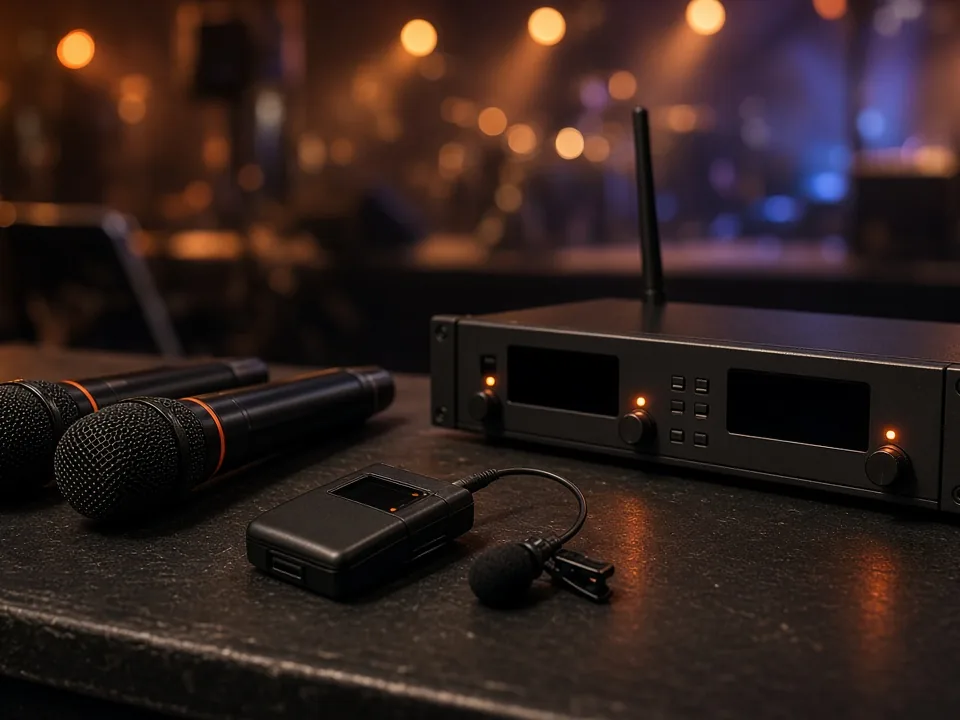
A wireless microphone system sends audio by radio from a transmitter—the handheld microphone or bodypack—to a receiver connected to the mixing console. It sounds simple, but reliable operation involves several factors.
Real-world performance depends on three essentials:
- Operating frequency assigned to the system
- Receiver and antenna quality
- The RF environment (radio-frequency conditions) at the venue
Problems occur when any one of these is poorly chosen or coordinated.
Wireless microphone frequency bands in Spain: digital TV and the 700 MHz spectrum
Professional wireless microphones in Spain commonly use UHF frequencies between 470 and 694 MHz, shared with terrestrial digital television (TDT). Under the Spanish National Frequency Allocation Table (CNAF), this is secondary use: microphones have no right to protection and must not interfere with television. Additional harmonised bands include 823–832 MHz and 1785–1805 MHz for professional applications, and 863–865 MHz, mainly intended for less demanding uses. UHF offers useful range and indoor penetration.
Important: However, not every frequency is available. Following the second digital dividend on 31 October 2020, the 700 MHz band (694–790 MHz) was assigned to 5G mobile networks; the 800 MHz band (790–862 MHz, except the 823–832 MHz gap) had already been assigned to mobile telephony. Wireless microphones in these restricted ranges are not permitted and will be exposed to serious interference. Older equipment must be retuned where possible or replaced.
Professional systems support frequency scanning before the event to identify unused channels. Although not a specific legal obligation, this is essential in practice.
02 · WIRELESS MICROPHONES
2. RF interference on the Costa del Sol: why it can be worse here
The Costa del Sol hosts an unusually high concentration of simultaneous events in peak season: weddings at private villas, hotel conferences, marquee performances and town fairs, sometimes taking place within a few kilometres of each other over the same weekend.
Each event can bring its own wireless microphone system. Unless someone coordinates the wireless microphone frequencies, the result can be predictable: cross-interference, noise, dropouts and lost signals.
Also consider the following local sources of RF interference:
- Digital television channels that occupy much of the 470–694 MHz band and vary between municipalities
- Wi-Fi networks in hotels and venues (2.4 and 5 GHz), particularly relevant to 2.4 GHz digital microphones
- Intercom systems used by security and production teams
- Wireless DMX lighting systems (often operating at 2.4 GHz)
- Mobile phone base stations in the 700 and 800 MHz bands, which can affect receivers operating close to band edges
In places such as Marbella or central Málaga, dozens of frequencies may already be occupied before the audio system is set up.
03 · WIRELESS MICROPHONES
3. Wireless microphone types and their best uses at events
Choosing the wrong transmitter for the application can also cause problems. These are the most common formats:
Handheld microphone
The most versatile option. Ideal for presenters, moving speakers and musical performances. Users can control their distance from the capsule, helping maintain a consistent audio level.
Lapel microphone
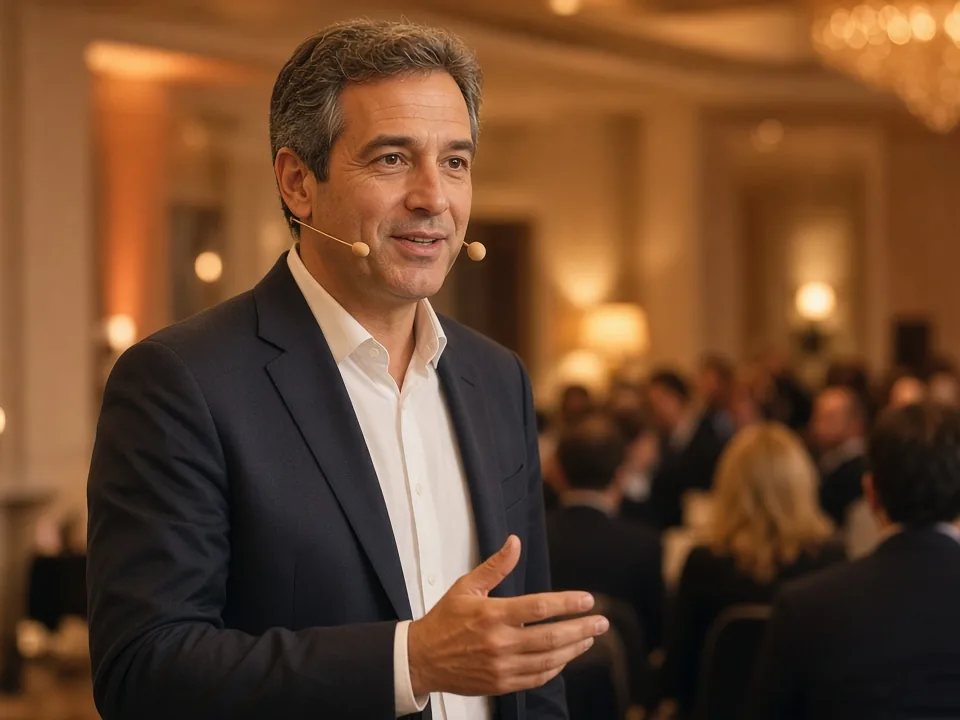
A lapel microphone (also called a lavalier) clips to clothing near the chest. It is popular for conferences, presentations and broadcasts because it leaves the hands free. At conferences it is often used alongside an LED screen or projector showing the presenter to the audience.
Its weakness is sensitivity to clothing rustle and outdoor wind. Bad placement can ruin the sound even when the radio link is flawless. Wind protection for outdoor ceremonies is one of the points in our wedding sound technical checklist.
Headset microphone
A headset microphone positions the capsule close to the mouth using a frame around the head or ear. It offers a strong signal-to-noise ratio because the capsule stays at a nearly constant distance from the lips.
It is widely used in musical theatre, stage performances and presentations involving movement. It is also becoming common for wedding celebrants.
04 · WIRELESS MICROPHONES
4. Common wireless microphone failures
Knowing the most frequent mistakes is the best way to avoid them. These are some of the problems we regularly encounter:
1. Skipping the frequency scan
Arriving at the venue, switching the equipment on and assuming the factory-set frequency is clear. This is one of the most common causes of dropouts.
2. Not checking batteries
A bodypack at 40% charge when the event begins is a failure waiting to happen. Professional practice is to start every event with new or fully charged batteries.
3. Poorly positioned antennas
Receiver antennas should have a clear path to the transmitters whenever possible. Placing them behind the console, backstage or inside a closed rack can drastically reduce the range.
4. Too many systems without frequency coordination
Using several rented wireless microphone systems from different brands or frequency ranges without coordinating them can create interference between the event's own systems, not just from external signals.
5. Poor-quality antenna cables
With antenna distribution systems, common at conferences using eight or more channels, unsuitable coaxial cable (such as long RG58 runs) or a corroded connector can degrade reception more than outside interference.

05 · WIRELESS MICROPHONES
5. Preparing wireless microphone frequency coordination for an event
Before any event using wireless microphones, follow at least this procedure:
- Scan the venue's RF spectrum using a spectrum analyser
- Assign frequencies from available spectrum, with correct channel spacing and avoidance of intermodulation products
- Check batteries are fully charged in every transmitter
- Inspect antennas and distribution equipment
- Perform a range test across the real operating area
- Prepare a backup plan: keep at least one wired microphone system available
Tip: This preparation is essential wherever failure is not an option.
06 · WIRELESS MICROPHONES
6. Frequently asked questions about wireless microphones
Which frequencies can wireless microphones use in Spain?
Mainly 470–694 MHz, shared with digital television on a secondary basis, plus harmonised bands at 823–832 MHz and 1785–1805 MHz. The 863–865 MHz range is primarily intended for non-professional use. Mobile networks use 694–790 MHz (700 MHz) and most of 790–862 MHz (800 MHz), except the 823–832 MHz gap.
My wireless microphone is on 700 or 800 MHz. Can I still use it?
Not if it transmits between 694 and 862 MHz outside the 823–832 MHz gap. Check the label and manual: some equipment can be retuned to a different authorised range; otherwise it must be replaced.
How many wireless microphones can run simultaneously?
It depends on the unused spectrum at the venue and on equipment quality. With an RF scan and frequency plan that avoids intermodulation, many channels can work together. Without coordination, even a few units can interfere with each other.
Is a lapel or headset better for a presenter?
A headset keeps the capsule at a consistent distance from the mouth and often provides more gain before feedback. A lapel is less visible but more vulnerable to clothing noise and wind. Outdoors or with active speakers, a headset with wind protection is often the safer choice.
Are 2.4 GHz digital wireless microphones a good option?
They are convenient for smaller events and do not require coordination with digital TV channels, but share spectrum with Wi-Fi and Bluetooth. In hotels and venues with many wireless networks, a properly coordinated UHF system is often more reliable.
07 · WIRELESS MICROPHONES
Conclusion: avoiding wireless microphone dropouts at your Málaga event
Reliable wireless microphones for events in Málaga need not be complicated when planned properly. Most failures come from shortcuts: frequencies that were never scanned, untested batteries and poorly positioned antennas.
RinconRock uses its own equipment and includes frequency coordination as a standard part of our wireless microphone hire service. If you have an event on the Costa del Sol and need dependable audio, contact us and we will advise you without obligation.
RINCONROCK RENTAL AV · RELATED RESOURCES
WIRELESS MICROPHONES
Using wireless microphones for events in Málaga presents a challenge that many organisers discover too late: the radio environment along the Costa del Sol is extremely busy. Peak tourism periods, several events running at once and dense hotel infrastructure all increase the potential for interference. This guide explains frequencies, what causes dropouts and how to prevent them before they disrupt your event.
470–694 MHz
UHF SHARED WITH DIGITAL TV
700 MHz
ASSIGNED TO 5G SINCE 2020
6 STEPS
PRE-EVENT PREPARATION
01 · WIRELESS MICROPHONES
1. How a professional UHF wireless system works
A wireless microphone system sends audio by radio from a transmitter—the handheld microphone or bodypack—to a receiver connected to the mixing console. It sounds simple, but reliable operation involves several factors.
Real-world performance depends on three essentials:
- Operating frequency assigned to the system
- Receiver and antenna quality
- The RF environment (radio-frequency conditions) at the venue
Problems occur when any one of these is poorly chosen or coordinated.
Wireless microphone frequency bands in Spain: digital TV and the 700 MHz spectrum
Professional wireless microphones in Spain commonly use UHF frequencies between 470 and 694 MHz, shared with terrestrial digital television (TDT). Under the Spanish National Frequency Allocation Table (CNAF), this is secondary use: microphones have no right to protection and must not interfere with television. Additional harmonised bands include 823–832 MHz and 1785–1805 MHz for professional applications, and 863–865 MHz, mainly intended for less demanding uses. UHF offers useful range and indoor penetration.
Important: However, not every frequency is available. Following the second digital dividend on 31 October 2020, the 700 MHz band (694–790 MHz) was assigned to 5G mobile networks; the 800 MHz band (790–862 MHz, except the 823–832 MHz gap) had already been assigned to mobile telephony. Wireless microphones in these restricted ranges are not permitted and will be exposed to serious interference. Older equipment must be retuned where possible or replaced.
Professional systems support frequency scanning before the event to identify unused channels. Although not a specific legal obligation, this is essential in practice.
02 · WIRELESS MICROPHONES
2. RF interference on the Costa del Sol: why it can be worse here
The Costa del Sol hosts an unusually high concentration of simultaneous events in peak season: weddings at private villas, hotel conferences, marquee performances and town fairs, sometimes taking place within a few kilometres of each other over the same weekend.
Each event can bring its own wireless microphone system. Unless someone coordinates the wireless microphone frequencies, the result can be predictable: cross-interference, noise, dropouts and lost signals.
Also consider the following local sources of RF interference:
- Digital television channels that occupy much of the 470–694 MHz band and vary between municipalities
- Wi-Fi networks in hotels and venues (2.4 and 5 GHz), particularly relevant to 2.4 GHz digital microphones
- Intercom systems used by security and production teams
- Wireless DMX lighting systems (often operating at 2.4 GHz)
- Mobile phone base stations in the 700 and 800 MHz bands, which can affect receivers operating close to band edges
In places such as Marbella or central Málaga, dozens of frequencies may already be occupied before the audio system is set up.
03 · WIRELESS MICROPHONES
3. Wireless microphone types and their best uses at events
Choosing the wrong transmitter for the application can also cause problems. These are the most common formats:
Handheld microphone
The most versatile option. Ideal for presenters, moving speakers and musical performances. Users can control their distance from the capsule, helping maintain a consistent audio level.
Lapel microphone
A lapel microphone (also called a lavalier) clips to clothing near the chest. It is popular for conferences, presentations and broadcasts because it leaves the hands free. At conferences it is often used alongside an LED screen or projector showing the presenter to the audience.
Its weakness is sensitivity to clothing rustle and outdoor wind. Bad placement can ruin the sound even when the radio link is flawless. Wind protection for outdoor ceremonies is one of the points in our wedding sound technical checklist.
Headset microphone
A headset microphone positions the capsule close to the mouth using a frame around the head or ear. It offers a strong signal-to-noise ratio because the capsule stays at a nearly constant distance from the lips.
It is widely used in musical theatre, stage performances and presentations involving movement. It is also becoming common for wedding celebrants.
04 · WIRELESS MICROPHONES
4. Common wireless microphone failures
Knowing the most frequent mistakes is the best way to avoid them. These are some of the problems we regularly encounter:
1. Skipping the frequency scan
Arriving at the venue, switching the equipment on and assuming the factory-set frequency is clear. This is one of the most common causes of dropouts.
2. Not checking batteries
A bodypack at 40% charge when the event begins is a failure waiting to happen. Professional practice is to start every event with new or fully charged batteries.
3. Poorly positioned antennas
Receiver antennas should have a clear path to the transmitters whenever possible. Placing them behind the console, backstage or inside a closed rack can drastically reduce the range.
4. Too many systems without frequency coordination
Using several rented wireless microphone systems from different brands or frequency ranges without coordinating them can create interference between the event's own systems, not just from external signals.
5. Poor-quality antenna cables
With antenna distribution systems, common at conferences using eight or more channels, unsuitable coaxial cable (such as long RG58 runs) or a corroded connector can degrade reception more than outside interference.
05 · WIRELESS MICROPHONES
5. Preparing wireless microphone frequency coordination for an event
Before any event using wireless microphones, follow at least this procedure:
- Scan the venue's RF spectrum using a spectrum analyser
- Assign frequencies from available spectrum, with correct channel spacing and avoidance of intermodulation products
- Check batteries are fully charged in every transmitter
- Inspect antennas and distribution equipment
- Perform a range test across the real operating area
- Prepare a backup plan: keep at least one wired microphone system available
Tip: This preparation is essential wherever failure is not an option.
06 · WIRELESS MICROPHONES
6. Frequently asked questions about wireless microphones
Which frequencies can wireless microphones use in Spain?
Mainly 470–694 MHz, shared with digital television on a secondary basis, plus harmonised bands at 823–832 MHz and 1785–1805 MHz. The 863–865 MHz range is primarily intended for non-professional use. Mobile networks use 694–790 MHz (700 MHz) and most of 790–862 MHz (800 MHz), except the 823–832 MHz gap.
My wireless microphone is on 700 or 800 MHz. Can I still use it?
Not if it transmits between 694 and 862 MHz outside the 823–832 MHz gap. Check the label and manual: some equipment can be retuned to a different authorised range; otherwise it must be replaced.
How many wireless microphones can run simultaneously?
It depends on the unused spectrum at the venue and on equipment quality. With an RF scan and frequency plan that avoids intermodulation, many channels can work together. Without coordination, even a few units can interfere with each other.
Is a lapel or headset better for a presenter?
A headset keeps the capsule at a consistent distance from the mouth and often provides more gain before feedback. A lapel is less visible but more vulnerable to clothing noise and wind. Outdoors or with active speakers, a headset with wind protection is often the safer choice.
Are 2.4 GHz digital wireless microphones a good option?
They are convenient for smaller events and do not require coordination with digital TV channels, but share spectrum with Wi-Fi and Bluetooth. In hotels and venues with many wireless networks, a properly coordinated UHF system is often more reliable.
07 · WIRELESS MICROPHONES
Conclusion: avoiding wireless microphone dropouts at your Málaga event
Reliable wireless microphones for events in Málaga need not be complicated when planned properly. Most failures come from shortcuts: frequencies that were never scanned, untested batteries and poorly positioned antennas.
RinconRock uses its own equipment and includes frequency coordination as a standard part of our wireless microphone hire service. If you have an event on the Costa del Sol and need dependable audio, contact us and we will advise you without obligation.
RINCONROCK RENTAL AV · RELATED RESOURCES
Wireless Microphones for Events in Málaga: Frequencies, Interference and Mistakes to Avoid