PROFESSIONAL LIGHTING
If you organise concerts, manage a music venue or run an entertainment business in Málaga, stage lighting is not a secondary detail: it is part of the show. Poor lighting design can ruin the audience experience even if the sound is perfect. This guide explains which fixtures are available, how to control them and how much electrical power to allow before plugging anything in.
512
CHANNELS PER DMX UNIVERSE
40–80 W
TYPICAL LED PAR POWER CONSUMPTION
+20–25%
RECOMMENDED ELECTRICAL HEADROOM
01 · PROFESSIONAL LIGHTING
1. Types of stage lighting fixtures: what you need and why
Not every fixture is suitable for every application. These are the main categories and when to use them.
LED PAR lights: the workhorses of any stage
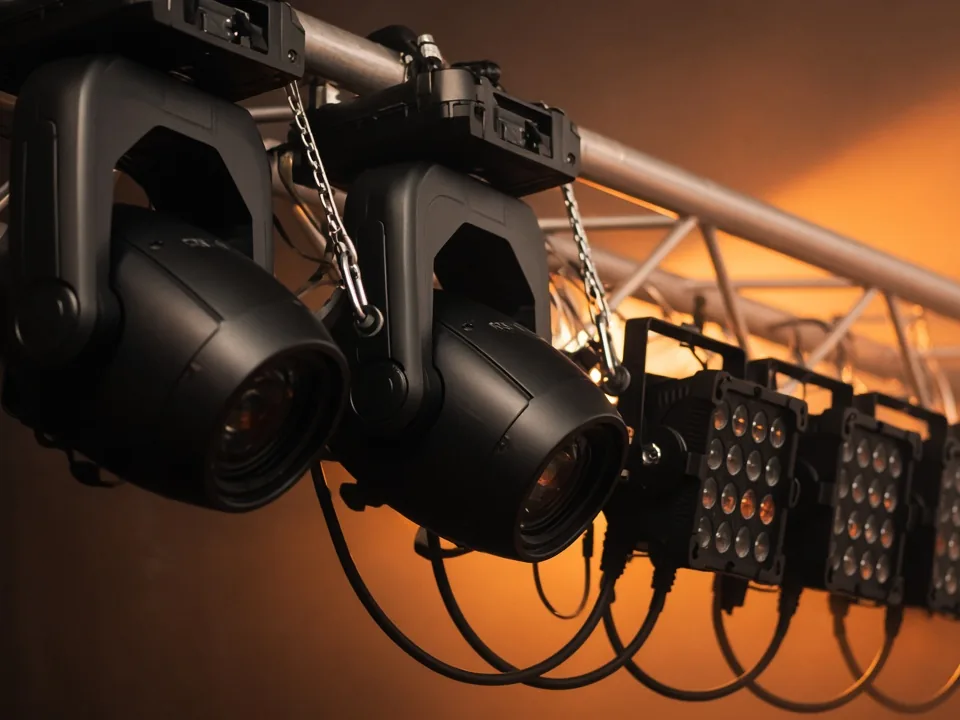
LED PAR fixtures are the foundation of many stage lighting systems. They provide a fixed beam, are robust, consume relatively little power and tolerate continuous operation in venues and on stages.
They work well for:
- General stage lighting (front, top or side light)
- Washing backgrounds and cycloramas with colour
- Permanent installations in hospitality venues or small live music rooms
- Weddings and social events where lighting is coordinated with décor and sound, as described in our wedding sound and lighting checklist
A mid-range LED PAR typically draws about 40–80 W, compared with 500–1,000 W for a conventional halogen PAR. The energy savings are substantial.
The range runs from compact PAR38-style units to powerful fixtures with RGBWA+UV colour mixing for professional colour control.
Moving heads: movement and complete creative control
Moving heads are a mainstay of larger productions. They pan, tilt, focus and change colour under programmed control, creating a completely different visual result from static lighting.
The main types are:
- Spot moving heads: produce a defined beam with gobos (patterns) and zoom. Ideal for nightclub effects and large concerts.
- Wash moving heads: produce a broader, more even field of light, ideal for illuminating performers or parts of a stage in colour.
- Beam moving heads: produce very narrow, intense beams designed for aerial effects with smoke or haze.
A mid- to high-range moving head may draw between 200 and 600 W. Electrical planning becomes essential when using several fixtures.
At RinconRock we regularly use these fixtures at events in Málaga and along the Costa del Sol. The question we hear most is, 'How many moving heads do I need?' The answer depends on stage size, trim height and the look you want. Without seeing the space, any number is only a rough guess.
Other common stage effects
As well as PARs and moving heads, a complete rig often includes:
- LED battens: even background or front-edge lighting
- Strobes: brief flash effects widely used in clubs
- Smoke machines and hazers: useful for making moving-head beams visible. Always inform the venue: atmospheric effects may activate fire detectors
- Pinspots: very narrow beams for specific subjects such as solo performers or decorative features
02 · PROFESSIONAL LIGHTING
2. DMX control: managing your entire lighting rig
The DMX lighting control protocol is the industry standard for controlling stage lighting fixtures. It uses 120-ohm data cable (microphone cable is not recommended) to connect devices in a daisy chain and send instructions from a console or controller. A segment supports up to 32 fixtures without a repeater or splitter and should have a terminating resistor at the end to prevent errors and flicker.
How does DMX512 work?
DMX512 carries 512 control channels per link, known as a universe. Each fixture uses one or more channels depending on its complexity:
- A simple RGB LED PAR may use 3 channels (red, green and blue)
- An advanced moving head may need 20 channels or more (pan, tilt, colour, gobo, zoom, strobe and more)
Every fixture has a DMX address set on the device, allowing the console to control it individually.
Types of DMX controllers
- Basic manual controllers: suitable for simple permanent installations, easy to use and inexpensive.
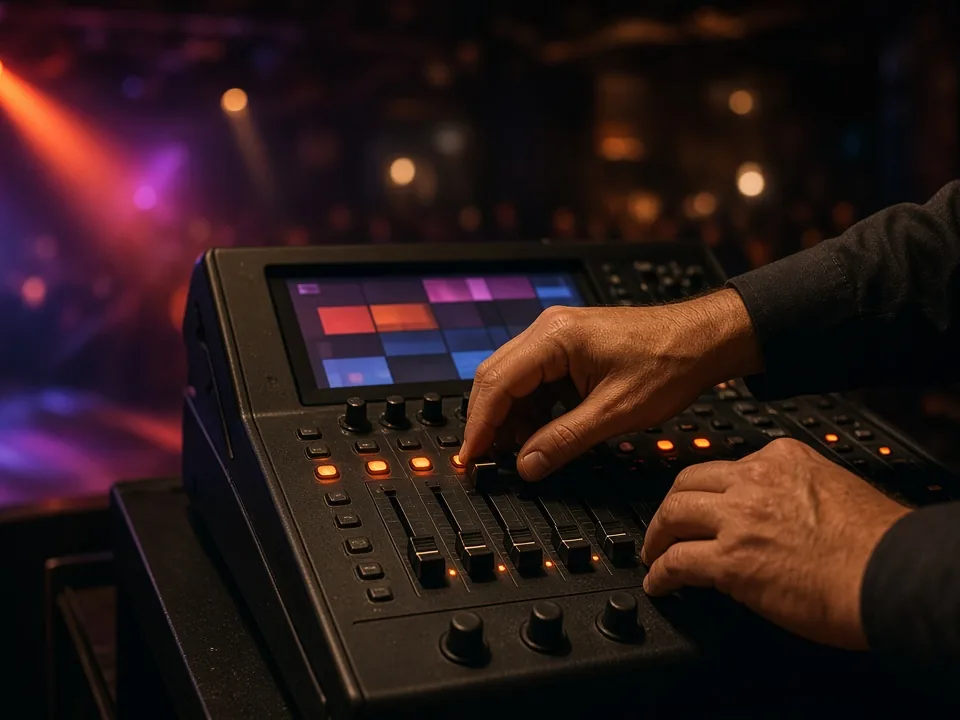
- Professional DMX consoles: designed for live productions, with programmable scenes, chases and music synchronisation.
- DMX software plus USB interface: a flexible solution for productions with a dedicated lighting operator, widely used in event production.
In nightclub lighting installations, audio-reactive or sound-to-light controllers are often combined with pre-programmed scenes.
03 · PROFESSIONAL LIGHTING
3. Stage electrical requirements: what often gets overlooked
Electrical capacity is one of the most underestimated factors. Connecting several stage lighting fixtures without checking the electrical installation can trip the supply mid-event or create a genuine safety hazard.
How to calculate the necessary power
The formula is simple:
Total power (W) = sum of the power ratings of all fixtures
Example for a medium-sized stage:
| Equipment | Quantity | W per fixture | Total |
|---|---|---|---|
| LED PAR fixtures | 8 | 60 W | 480 W |
| Wash moving heads | 4 | 250 W | 1,000 W |
| Spot moving heads | 2 | 350 W | 700 W |
| LED battens | 2 | 80 W | 160 W |
| Strobes | 2 | 200 W | 400 W |
| TOTAL | 2,740 W |
Tip: Always add an extra 20–25% allowance for start-up peaks and to avoid running the supply at its absolute limit.
In the example above, you would need capacity for at least 3,500 W continuously. On a 230 V single-phase supply that is around 15 A: a single 16 A circuit is too close to its limit, so distributing the load across at least two independently protected circuits is advisable.
What to check before installation
- Available electrical capacity at the venue: how much remains after the sound systemis accounted for?
- Supply type: single-phase or three-phase
- Condition of the distribution board: suitable RCDs and circuit breakers for each circuit and proper earthing. Temporary installations must comply with Spain's Low Voltage Electrotechnical Regulation (REBT)
- Distance to the load: longer cable runs increase voltage drop
Important: When arranging concert lighting hire, insist that the supplier provides the power consumption specification for every fixture. A professional company should have this information readily available.
04 · PROFESSIONAL LIGHTING
4. Frequently asked questions about stage lighting
How many moving heads do I need for a stage?
It depends on stage width and depth, rigging height and the desired effect. For a small venue, a few wash fixtures for performers and some spots or beams for effects may be sufficient. The correct specification follows a site assessment.
How many fixtures can a DMX line support?
A DMX512 universe has 512 channels, shared according to the footprint of each fixture. Electrically, a segment supports up to 32 devices; larger installations or branches require a DMX splitter. Each line must be terminated correctly.
Can I use microphone cable for DMX?
It is not recommended. DMX is designed for 120-ohm cable; microphone cable can degrade the signal and lead to flicker or erratic movement, particularly with long runs or many fixtures.
How much electrical power does lighting need?
Add the ratings of every fixture and allow another 20–25%. A 230 V single-phase 16 A circuit provides a theoretical maximum of about 3,680 W, so medium rigs should spread the load over several circuits and larger rigs may need three-phase power.
Can smoke or haze activate a fire alarm?
Yes. Always coordinate with the venue manager, who will decide how detection is managed during the event. Never disable detectors without the appropriate authorisation.
05 · PROFESSIONAL LIGHTING
Conclusion: properly planned stage lighting in Málaga
Professional stage lighting in Málaga involves much more than plugging in lights. It combines aesthetic judgement, equipment knowledge, the DMX protocol and electrical planning. Getting it right in advance avoids problems on show day, just as it does with sound. See our wedding sound and lighting guide.
At RinconRock we have more than fifteen years of experience in lighting installations and productions across Málaga province and the Costa del Sol, from entertainment venues to major live events. If a fixture fails, our technical team can often resolve it quickly because we have an in-house workshop equipped for most repairs. If you need concert lighting hire, a permanent installation or simply technical advice without obligation, contact us. We assess each project realistically, without selling you equipment you do not need.
RINCONROCK RENTAL AV · RELATED RESOURCES
PROFESSIONAL LIGHTING
If you organise concerts, manage a music venue or run an entertainment business in Málaga, stage lighting is not a secondary detail: it is part of the show. Poor lighting design can ruin the audience experience even if the sound is perfect. This guide explains which fixtures are available, how to control them and how much electrical power to allow before plugging anything in.
512
CHANNELS PER DMX UNIVERSE
40–80 W
TYPICAL LED PAR POWER CONSUMPTION
+20–25%
RECOMMENDED ELECTRICAL HEADROOM
01 · PROFESSIONAL LIGHTING
1. Types of stage lighting fixtures: what you need and why
Not every fixture is suitable for every application. These are the main categories and when to use them.
LED PAR lights: the workhorses of any stage
LED PAR fixtures are the foundation of many stage lighting systems. They provide a fixed beam, are robust, consume relatively little power and tolerate continuous operation in venues and on stages.
They work well for:
- General stage lighting (front, top or side light)
- Washing backgrounds and cycloramas with colour
- Permanent installations in hospitality venues or small live music rooms
- Weddings and social events where lighting is coordinated with décor and sound, as described in our wedding sound and lighting checklist
A mid-range LED PAR typically draws about 40–80 W, compared with 500–1,000 W for a conventional halogen PAR. The energy savings are substantial.
The range runs from compact PAR38-style units to powerful fixtures with RGBWA+UV colour mixing for professional colour control.
Moving heads: movement and complete creative control
Moving heads are a mainstay of larger productions. They pan, tilt, focus and change colour under programmed control, creating a completely different visual result from static lighting.
The main types are:
- Spot moving heads: produce a defined beam with gobos (patterns) and zoom. Ideal for nightclub effects and large concerts.
- Wash moving heads: produce a broader, more even field of light, ideal for illuminating performers or parts of a stage in colour.
- Beam moving heads: produce very narrow, intense beams designed for aerial effects with smoke or haze.
A mid- to high-range moving head may draw between 200 and 600 W. Electrical planning becomes essential when using several fixtures.
At RinconRock we regularly use these fixtures at events in Málaga and along the Costa del Sol. The question we hear most is, 'How many moving heads do I need?' The answer depends on stage size, trim height and the look you want. Without seeing the space, any number is only a rough guess.
Other common stage effects
As well as PARs and moving heads, a complete rig often includes:
- LED battens: even background or front-edge lighting
- Strobes: brief flash effects widely used in clubs
- Smoke machines and hazers: useful for making moving-head beams visible. Always inform the venue: atmospheric effects may activate fire detectors
- Pinspots: very narrow beams for specific subjects such as solo performers or decorative features
02 · PROFESSIONAL LIGHTING
2. DMX control: managing your entire lighting rig
The DMX lighting control protocol is the industry standard for controlling stage lighting fixtures. It uses 120-ohm data cable (microphone cable is not recommended) to connect devices in a daisy chain and send instructions from a console or controller. A segment supports up to 32 fixtures without a repeater or splitter and should have a terminating resistor at the end to prevent errors and flicker.
How does DMX512 work?
DMX512 carries 512 control channels per link, known as a universe. Each fixture uses one or more channels depending on its complexity:
- A simple RGB LED PAR may use 3 channels (red, green and blue)
- An advanced moving head may need 20 channels or more (pan, tilt, colour, gobo, zoom, strobe and more)
Every fixture has a DMX address set on the device, allowing the console to control it individually.
Types of DMX controllers
- Basic manual controllers: suitable for simple permanent installations, easy to use and inexpensive.
- Professional DMX consoles: designed for live productions, with programmable scenes, chases and music synchronisation.
- DMX software plus USB interface: a flexible solution for productions with a dedicated lighting operator, widely used in event production.
In nightclub lighting installations, audio-reactive or sound-to-light controllers are often combined with pre-programmed scenes.
03 · PROFESSIONAL LIGHTING
3. Stage electrical requirements: what often gets overlooked
Electrical capacity is one of the most underestimated factors. Connecting several stage lighting fixtures without checking the electrical installation can trip the supply mid-event or create a genuine safety hazard.
How to calculate the necessary power
The formula is simple:
Total power (W) = sum of the power ratings of all fixtures
Example for a medium-sized stage:
| Equipment | Quantity | W per fixture | Total |
|---|---|---|---|
| LED PAR fixtures | 8 | 60 W | 480 W |
| Wash moving heads | 4 | 250 W | 1,000 W |
| Spot moving heads | 2 | 350 W | 700 W |
| LED battens | 2 | 80 W | 160 W |
| Strobes | 2 | 200 W | 400 W |
| TOTAL | 2,740 W |
Tip: Always add an extra 20–25% allowance for start-up peaks and to avoid running the supply at its absolute limit.
In the example above, you would need capacity for at least 3,500 W continuously. On a 230 V single-phase supply that is around 15 A: a single 16 A circuit is too close to its limit, so distributing the load across at least two independently protected circuits is advisable.
What to check before installation
- Available electrical capacity at the venue: how much remains after the sound systemis accounted for?
- Supply type: single-phase or three-phase
- Condition of the distribution board: suitable RCDs and circuit breakers for each circuit and proper earthing. Temporary installations must comply with Spain's Low Voltage Electrotechnical Regulation (REBT)
- Distance to the load: longer cable runs increase voltage drop
Important: When arranging concert lighting hire, insist that the supplier provides the power consumption specification for every fixture. A professional company should have this information readily available.
04 · PROFESSIONAL LIGHTING
4. Frequently asked questions about stage lighting
How many moving heads do I need for a stage?
It depends on stage width and depth, rigging height and the desired effect. For a small venue, a few wash fixtures for performers and some spots or beams for effects may be sufficient. The correct specification follows a site assessment.
How many fixtures can a DMX line support?
A DMX512 universe has 512 channels, shared according to the footprint of each fixture. Electrically, a segment supports up to 32 devices; larger installations or branches require a DMX splitter. Each line must be terminated correctly.
Can I use microphone cable for DMX?
It is not recommended. DMX is designed for 120-ohm cable; microphone cable can degrade the signal and lead to flicker or erratic movement, particularly with long runs or many fixtures.
How much electrical power does lighting need?
Add the ratings of every fixture and allow another 20–25%. A 230 V single-phase 16 A circuit provides a theoretical maximum of about 3,680 W, so medium rigs should spread the load over several circuits and larger rigs may need three-phase power.
Can smoke or haze activate a fire alarm?
Yes. Always coordinate with the venue manager, who will decide how detection is managed during the event. Never disable detectors without the appropriate authorisation.
05 · PROFESSIONAL LIGHTING
Conclusion: properly planned stage lighting in Málaga
Professional stage lighting in Málaga involves much more than plugging in lights. It combines aesthetic judgement, equipment knowledge, the DMX protocol and electrical planning. Getting it right in advance avoids problems on show day, just as it does with sound. See our wedding sound and lighting guide.
At RinconRock we have more than fifteen years of experience in lighting installations and productions across Málaga province and the Costa del Sol, from entertainment venues to major live events. If a fixture fails, our technical team can often resolve it quickly because we have an in-house workshop equipped for most repairs. If you need concert lighting hire, a permanent installation or simply technical advice without obligation, contact us. We assess each project realistically, without selling you equipment you do not need.
RINCONROCK RENTAL AV · RELATED RESOURCES
Stage Lighting in Málaga: PAR Lights, Moving Heads, DMX and Power Requirements